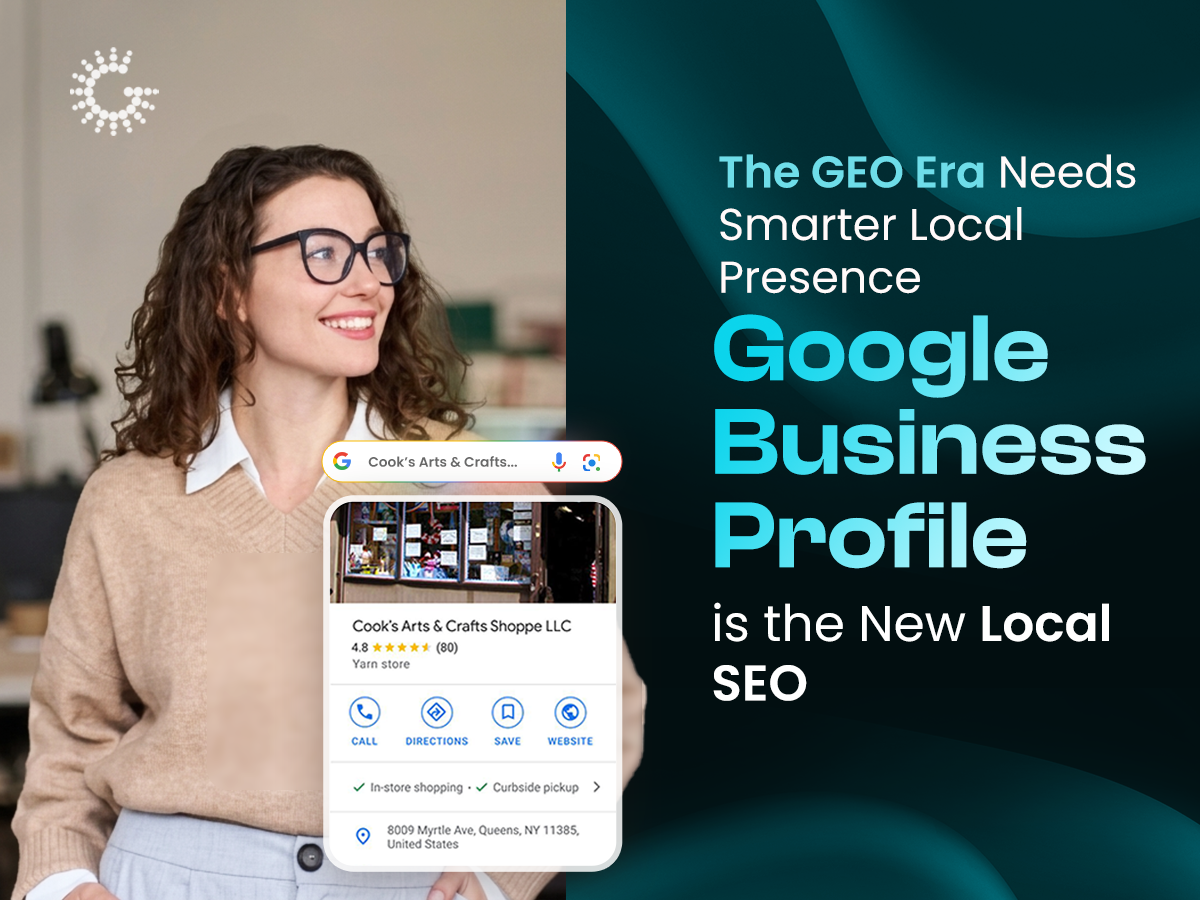
Most businesses treated their Google Business Profile like a basic Maps listing. Put in the address, add the phone number, upload a few photos, and maybe ask a couple of happy customers for reviews. Then leave it alone.
That worked for a while. But not anymore.
People still search for things like “plumber near me,” for example. Of course they do. But now they search differently too. They ask real questions, the kind they would ask a friend:
People want to quickly compare you, and Google wants to understand what you do. AI search tools need clear facts before they can mention or recommend a business.
That is why some marketers talk about GEO, or Generative Engine Optimization. The idea is to make your business easy for people, Google, and AI search to understand.
Your website still tells the bigger story. But your Google Business Profile backs up the basics in a place people already look:
A strong profile does not mean you will magically appear in AI-generated answers. Anyone who promises that is selling too hard. But it does give Google, Maps, customers, and AI tools better information to work with. And that is very important.
Because before someone calls you, they usually check you. Your Google Business Profile is one of the first places they look.
Old local SEO was mostly about ranking in Google Search and Google Maps. Someone searched, and Google returned map results, local listings, websites, and ads.
That still happens every day. But now people search more humanly. They ask full questions and compare businesses before they click. They want to know what to ask, who to trust, what the process looks like, and who can help with their exact problem. That changes the job your business information has to do.
In the old search journey, your business needed to rank and win the click. Now your business also needs to be clear enough to be understood, compared, summarized, and recommended. That is a bigger job.
If your profile is thin, vague, or outdated, you make that job harder. If your category is wrong, your services are unclear, your reviews are weak, your hours are old, or your contact details do not match across the web, customers may skip you. Search systems may struggle too.
A vague profile creates weak context, whereas a clear profile creates stronger context. And in local search, context is money.
Google Business Profile helps customers see the basic facts about your business:
For a local business, these details are the first things customers see. Sometimes they never visit your website at all. They read your reviews, check your hours, look at your photos, and call straight from your profile.
That call still counts and that customer is still important of course. This is why your profile should not be treated like a form you filled out once years ago. It is one of the clearest public summaries of your business. And in the GEO era, clarity counts even more.
AI search does not replace SEO. It puts more pressure on the same things that already were important. Think useful information, real trust, clean data, and a good customer experience.
So no, GEO is not some magic trick. For most local businesses, GEO starts with solid SEO basics, and Google Business Profile is one of them.
Search engines do not only look at your website. They try to understand your business as an entity. That means they need answers to basic questions:
Your Google Business Profile brings many of those answers into one public place. That helps customers. It also helps search systems.
For example, a plumbing company that says “we provide home services” is hard to understand. A plumbing company that clearly lists emergency plumbing, leak repair, drain cleaning, water heater installation, pipe repair, and bathroom plumbing is much easier to understand. That kind of detail helps connect the business to the right search.
The goal is not to stuff keywords into every corner of the profile. That looks bad, and it misses the point. The goal is to make the business easy to understand.
People still want nearby businesses. But “nearby” is only one part of the decision. A customer might ask:
These are local searches, yes. But they are also service searches, trust searches, urgency searches, and decision searches. That means a basic profile is not enough.
Your profile should help answer the questions a buyer has before they reach your site:
A lot of businesses miss this. They add the bare minimum: name, phone, address, website. Then they leave the profile alone. In AI-assisted search, thin information gives weak signals. Strong information gives people and search systems more to work with.
Not everyone lands on your homepage first. Some people find you on Google Maps. Some compare reviews in the search results. Some look at your photos before they even think about your website. Some call from your profile without clicking anything.
That means your Google Business Profile may be the first impression. And people judge fast.
If your hours are wrong, your photos look old, you have no service details, or your reviews are weak or ignored, that will hurt. And if your phone number is wrong, that is worse. That is lost business.
Picture two companies. One has clear services, strong reviews, recent photos, correct hours, and a working phone number. The other has three old reviews, no description, no recent activity, and hours that may or may not be right.
Most people will call the first one. That is not complicated.
And while AI tools are not human, they still depend on clear public information. Stronger signals make your business easier to understand and evaluate.
A profile alone is not enough. Your website, reviews, local pages, technical SEO, citations, and lead process are still crucial. But without a strong Google Business Profile, many local businesses leave a big trust gap wide open.
A strong Google Business Profile isn’t built on one thing. It comes from several parts working together.
Categories: Your categories help Google understand what kind of business you are. They also help customers decide if you match what they need.
If your category is too broad, too vague, or just wrong, your profile may not align with the searches you want. Pick categories that match the real business.
Services: Many businesses choose a category and then ignore the service section. The service section is where you can explain what you actually do.
So in the case of a plumbing company, “home services” does not say enough. Does that mean leak repair? Drain cleaning? Water heater installation? Emergency plumbing? Bathroom plumbing?
People should not have to guess. Customers think in terms of problems, while businesses think in terms of services. Your profile has to connect the two.
Reviews: Reviews are proof. They show whether real customers trust the business and also give future customers the kind of detail your own marketing misses.
A business can say, “We offer reliable service.” Fine. But a review that says, “This contractor arrived on time, fixed the problem quickly, and explained the cost clearly” is stronger. It is specific. It sounds real because it is real.
But reviews have to be earned the right way. Do not buy fake reviews and write your own. Do not pressure people into saying things that are not true.
Ask happy customers at the right time. Respond like a real person. And learn from the bad reviews too. That is how trust builds.
Photos: Service businesses treat photos like an afterthought. They should not because photos make a business feel real.
Do not dump random images into the profile. Use photos that help someone feel more sure about calling you. In a world full of generic content, real photos help prove there is a real business behind the listing.
Consistency: Your Google Business Profile should match the rest of your online presence. That means your business name, phone number, address or service area, website, hours, services, categories, and social links should line up across your website, directories, review sites, and social profiles.
If your website shows one phone number and your profile shows another, people hesitate. If your Google profile has old hours and your website has new hours, people get annoyed. If an old directory lists a former address, that creates confusion. Search systems may also trust the information less.
Website alignment: Your profile and your website should support each other. If people click from a service on your profile and land on a vague homepage, you may lose them. Send them somewhere useful when possible.
Many people do not click right away. They compare reviews, look at photos, check services, read hours, ask for directions, and call from the profile. That is called a zero-click journey.
Some businesses panic about that because they want more website traffic. But traffic is not the point. Leads are the point.
If someone calls from your Google Business Profile or if someone asks for directions, that is valuable. If someone books, messages, or requests a quote without visiting your site, that is still business.
In AI-assisted search, this will be even more important. People may get part of the answer before they click anything. So your profile has to be ready for action. Do the following:
Service-area businesses have a harder job than stores with walk-in traffic. They may serve several cities and rely on no public storefront at all. That includes contractors, home service providers, clinics, legal professionals, real estate services, consultants, training companies, marketing agencies, IT companies, and many B2B service providers.
For these businesses, the profile has to answer a few things fast:
Most profile problems are not huge. They are small things that pile up.
Vague descriptions: “We provide quality services for local customers.” That says almost nothing. A better description would be: “Our company helps homeowners and businesses with emergency plumbing, leak repair, drain cleaning, water heater installation, and pipe repair across the local service area.”
Wrong categories: Bad categories weaken relevance. If your main category does not match what your business actually does, you make it harder for Google and customers to understand you. Review categories when your services change. Do not set them once and forget them.
Thin service sections: Your services should not be empty or vague. They should help people decide if you can solve their problem. A customer should quickly understand what you offer, where you work, and what to do next.
Ignored reviews: Not replying to reviews makes a business look absent. Responses do not need to be long, but they do need to sound human. Thank people. Be specific when it makes sense. Handle complaints professionally. Do not copy and paste the same response every time because people can tell.
Old photos: Old photos make a business feel neglected. Keep the profile alive with current, useful images. Show your team, work, office, vehicles, equipment, projects, or customer-facing spaces. Fresh photos help people feel like the business is active.
Mismatched contact details: Wrong phone numbers, old addresses, outdated hours, and broken links cost real leads. This is basic, but basic mistakes still hurt. Check them regularly.
Weak website links: A good profile can win attention, but a bad website page can lose it. If someone clicks through and lands on a slow, unclear, outdated page, they may leave. Your profile and website should work together, not fight each other.
Chasing AI visibility before fixing the basics: Some businesses want to talk about GEO while their Google Business Profile is half empty. That is the wrong order. Fix the basics first. Complete the profile, clean up the details, add services, improve reviews, update photos, and align the website. Then talk about AI search readiness.
Start with accuracy. Check the business name, phone number, website, hours, holiday hours, address or service area, map pin, business description, and contact options. If those are wrong, everything else is weaker.
Then review your categories. Your primary category should match your main business. Secondary categories should support the real services you offer.
Next, rewrite the business description. Do not write something that sounds like it came from a brochure. Say what you do, who you help, and where you work.
After that, update your services. Keep the service names clear. Add short descriptions where useful.
Then refresh your photos. People want proof that the business is real, organized, and active.
Next, build a steady review process. Ask real customers for honest feedback and make the process easy. Respond professionally and do not copy and paste your responses.
Then make sure the profile and website line up. If your profile attracts people looking for a particular service, send them to that page if you have one.
Finally, track what is important to your business. Calls, clicks, direction requests, messages, bookings, reviews, lead quality, form submissions, conversion rates, etc. Do not only stare at impressions. Visibility is nice, but leads pay the bills.
Google Business Profile sits right between local SEO and AI search readiness.
For SEO, it helps your business show up in Google Search and Google Maps. It supports local visibility, reviews, map presence, and customer actions. For GEO, it helps create a clearer public picture of the business. It gives search systems and AI-assisted tools structured information about your services, location, reputation, and activity.
That combination is powerful.
SEO helps people find you. GEO helps people and search systems understand you. Google Business Profile supports both.
But let’s be clear. A strong profile is not enough on its own. You still need a useful website, strong service pages, technical SEO, real reviews, local citations, clear contact paths, tracking, good user experience, consistent business information, and a clean conversion process.
And no one should promise that a Google Business Profile will get your business into AI-generated answers. That is not how this works.
But a good profile can make your business easier to understand, easier to trust, and harder to overlook. That is worth doing.
TechGlobe IT Solutions helps businesses improve local SEO, Google Business Profile performance, and AI search readiness through a connected digital marketing strategy. That can include profile audits, accuracy checks, category and service updates, business description improvements, review strategy, photo recommendations, local SEO, service-page improvements, citation checks, Google Ads support, content marketing, technical SEO, lead tracking, reporting, and AI search preparation.Contact TechGlobe IT Solutions today to get started.
Google Business Profile is a free listing that lets businesses manage how they appear on Google Search and Google Maps. It can show your business name, location, phone number, website, hours, reviews, photos, services, updates, and contact options. For local and service-area businesses, it is one of the most important public sources of business information.
Because people and search systems need clear, accurate, trusted information. As more people use conversational and AI-assisted search, your business needs to be easy to understand and compare. A complete profile helps show what you do, where you work, how people can contact you, and why they might trust you.
No. It is a major part of local SEO, but it also supports broader visibility. Your profile helps define your business identity, services, location, reviews, and public trust. Those details can support both traditional search and AI-assisted search journeys.
It can help with readiness, but it does not guarantee placement in AI-generated answers. A strong profile makes your business information clearer, more consistent, and easier to understand. That helps with local SEO, AI-assisted discovery, and customer decision-making.
The biggest pieces are accurate contact information, correct categories, clear services, a useful description, reviews, photos, hours, website link, service area, updates, and questions and answers. Together, these help customers and search systems better understand the business.
Review it at least once a month. Also, update it whenever your hours, services, contact details, photos, offers, location, website link, or business information changes. An active profile looks more reliable than one that has been ignored.
It depends on what the customer needs. For some businesses, the homepage works fine. For others, a service page or location page is better. If someone needs emergency plumbing, a dedicated emergency plumbing page may help more than a general homepage.
GEO, or Generative Engine Optimization, refers to preparing content and business information for AI-assisted search. But for most businesses, GEO should not replace SEO. Good GEO readiness starts with good SEO basics: useful content, clear business information, technical SEO, real reviews, consistent data, and a good user experience.
Yes. TechGlobe IT Solutions helps businesses improve their Google Business Profile visibility, local SEO, website performance, content strategy, paid advertising, and AI search-readiness. The team can audit your profile, improve your business information, align your services with your website, support your review strategy, and help you track important actions.