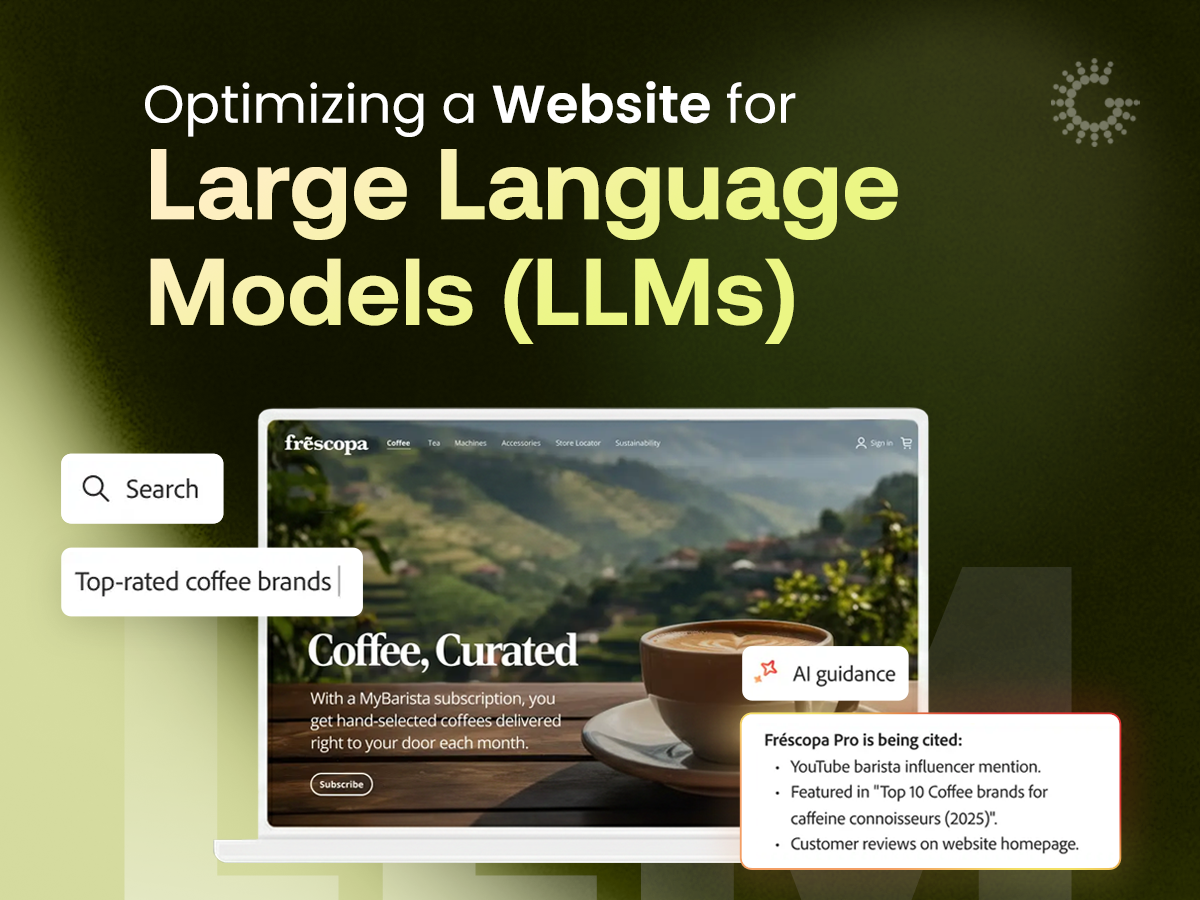
Search visibility is no longer just “rank and get the click.” Large language models (LLMs) now sit between users and information. Tools like ChatGPT, Gemini, Claude, Perplexity and AI search experiences increasingly answer questions directly. And they mostly do it without sending the user to a website.
This fundamentally changes the goal.
You are no longer competing only for blue-link positions in search results. You are competing to become source material, the content that AI systems trust enough to extract from and recommend when users ask questions.
Optimizing for LLMs means designing your website and content so it is:
In short, LLM optimization is all about making sure that when AI systems generate answers in your category, your brand and expertise are part of the conversation and represented accurately. Below is your practical guide for doing exactly that.
LLM optimization is the practice of improving how AI systems find and represent your brand and content in generated answers. Traditional SEO asks, “Where do we rank?” LLM optimization asks, “Are we cited and recommended? And how are we described when we are?”
That difference matters more than it may seem.
In an AI-driven search environment:
Because of this, optimization is no longer about forcing a page to rank for a single query. It is about shaping how your information is interpreted and reused.
Effective LLM optimization focuses on three core outcomes:
In other words, you are optimizing for reference value. The goal is to make your content easy to extract and credible enough to be reused as part of an AI-generated answer.
This will set the foundation for everything that follows.
Optimizing for LLMs is not about chasing every new AI feature or rewriting your entire site overnight. The biggest gains come from a focused set of strategies that directly influence how models retrieve, extract and recommend information.
LLMs surface content based on how people ask questions, not how marketers traditionally target keywords. Queries are longer, more conversational. And they often include context or intent that never appeared in classic keyword tools.
Your first step is building a prompt map that mirrors real customer thinking. Instead of asking, “What keywords should we rank for?” ask, “What would a real person ask an AI when they are trying to understand or choose a solution like ours?”
Create three core prompt sets:
Awareness prompts (top of funnel): These focus on education and understanding the problem.
Comparison prompts (mid-funnel): These signal evaluation and shortlisting.
Decision prompts (bottom-funnel): These indicate buying or selection intent.
Prioritize bottom-funnel prompts first. Being recommended when someone is actively choosing a product or partner is typically far more valuable than being mentioned in a generic definition.
What to publish from this exercise:
When your pages mirror the structure of real prompts, AI systems can more easily map your content to user intent and surface it at the right moment.
LLMs reward content that can be cleanly lifted into a response. If a model has to “hunt” for the answer or stitch together meaning from multiple paragraphs, it is far less likely to use your content.
The rule is simple: answer the question immediately. Use these writing principles consistently:
A reliable, high-performing section follows a predictable structure:
This format works for humans because it’s scannable and decisive. And it works for AI systems because the core answer is explicit, structured and easy to reuse. If you want to appear in AI-generated responses, your content must be written as if it is already being quoted.
LLMs tend to rely on sources that demonstrate a comprehensive understanding. A site with a few deeply developed resources often outperforms one with dozens of thin, overlapping articles, even if the latter targets more keywords.
Instead of publishing 30 posts that all slightly rephrase the same idea, focus on building topical authority through intentional depth. The most effective approach is a topic cluster model that fully answers a domain of related questions:
This structure sends a strong signal to both crawlers and language models that your site is an expert on the topic.
Internal linking is what makes this authority legible:
The goal is to create a clear, consistent knowledge graph where:
When models see repeated, aligned explanations across multiple pages, confidence increases and confident sources are far more likely to be cited or summarized in AI-generated answers.
Depth beats volume because it reduces contradiction, increases clarity and positions your site as a reliable reference hub rather than a collection of loosely related posts.
LLMs build internal representations of entities: brands, products, people, categories and how those entities relate to one another. If your site is vague or inconsistent about who you are and what you offer, AI-generated answers will be vague too, or worse, incorrect.
Start by tightening the fundamentals on your own site.
On-site essentials:
Avoid relying on implied meaning. Spell things out in plain language.
Language and naming discipline:
This repetition is for interpretation accuracy. When the same descriptors appear across multiple pages, models can confidently associate your brand with the right category and use cases.
The stronger and more consistent your entity signals are, the more likely AI systems are to:
LLMs tend to favor content that looks grounded in reality. When multiple sources discuss a topic, models are more likely to surface information that includes specific numbers, attributed statements and concrete examples. In short, claims without proof are easy to ignore.
Add proof points deliberately throughout your content:
Outdated data is one of the most common reasons AI systems bypass otherwise solid pages. When newer sources exist, models tend to favor them, even if the underlying insight has not changed.
To stay competitive:
Proof turns your content from opinion into reference material. And reference-worthy content is exactly what LLMs are looking for when assembling answers.
Structured data is a machine-readable layer that helps AI systems interpret what a page is about and which information should be treated as authoritative.
In an LLM context, schema helps reduce ambiguity. When content is clearly labelled, models are less likely to include the wrong details in their answers.
Prioritize schema types that align with how AI systems commonly respond to questions:
Two implementation details are more crucial than anything else:
Many AI-generated answers follow predictable patterns. There are lists of options, side-by-side comparisons, pros and cons and decision recommendations. If your pages don’t align with these patterns, they are far less likely to be cited, even if the content itself is strong.
Design pages explicitly to be reference material.
Comparison pages:
Best-of pages:
Use-case and constraint-driven pages:
These formats map directly to how AI systems assemble answers. When your content already resembles the structure of a generated response, it becomes easy for models to reuse.
Even the best content will not surface in AI-generated answers if systems can’t reliably access or parse it. Technical friction is often invisible, but it is one of the fastest ways to lose LLM visibility entirely.
Run a technical audit with extraction and interpretation in mind.
Crawlability and indexation:
Rendering and readability:
Performance and mobile experience:
Content accessibility:
Think of this step as removing friction between your content and the systems trying to understand it. When access is clean and structure is clear, everything else you have optimized has a chance to work.
LLMs don’t learn or retrieve from your website in isolation. They rely on the broader web to validate what’s true, credible, and widely accepted. If your brand narrative only exists on your own pages, AI systems have fewer trust signals to work with.
Off-site presence acts as corroboration. It confirms that what you claim about yourself is reflected elsewhere—and said consistently.
Backlinks still matter. But in an LLM-driven ecosystem, quality and context matter far more than raw volume.
Prioritize earning mentions from sources that already carry trust in your space:
Unlinked brand mentions are also valuable. When your brand is referenced repeatedly and consistently across credible sources, AI systems can treat those mentions as confirmation signals even without a hyperlink.
Be selective about what you avoid:
These tactics can actively harm trust signals that AI systems rely on.
Think of this as building a consistent information footprint so AI encounters the same story about your brand in multiple places.
Create, claim and maintain:
The goal is to be consistent everywhere that matters. When AI systems see the same positioning language, category definitions and differentiators repeated across trusted sources, confidence increases. And confident models are far more likely to recommend you accurately.
You can’t improve what you don’t track and LLM visibility often doesn’t show up clearly in traditional SEO dashboards. Rankings and clicks tell only part of the story. To measure progress effectively, you need a different lens.
Set up a simple reporting framework focused on how your brand appears in AI-generated answers.
Inclusion (binary presence):
Positioning (share of voice):
Portrayal (narrative and sentiment):
Because AI outputs are variable, measure trends across multiple runs and time periods rather than treating a single response as definitive.
Where possible, isolate traffic coming from AI tools and AI-driven search experiences in your analytics.
Track:
This data helps you identify which pages AI systems already trust and where small improvements could lead to outsized gains. Optimize the pages that AI is actually sending users to.
As AI-driven search and answer engines evolve, LLM visibility becomes more dynamic and more competitive. Teams that treat optimization as a one-time project will fall behind quickly. The advantage goes to those who operationalize it.
LLM recommendations can change rapidly as new sources appear, competitors update content or retrieval mechanisms change. Even high-performing pages can lose visibility if they stagnate.
Operationally, that means:
Freshness is a signal that your content is still safe to reference.
If AI systems misrepresent your brand, the fix is usually in the underlying information environment. To correct or prevent misrepresentation:
The more consistently your narrative appears across trusted sources, the harder it is for AI to get it wrong.
LLM optimization is an extension of SEO. Traditional SEO builds crawlability, authority, and discoverability. LLM optimization verifies that content is extractable and reference-worthy.
Teams that win don’t split these efforts into silos. They treat search, content, PR and brand as one integrated visibility system designed for both humans and machines.
To optimise a website for LLMs, stop thinking only in terms of rankings and start thinking in terms of reference value.
In an AI-driven landscape, visibility does not always look like a click. It looks like being cited in an answer, recommended in a comparison or summarized as the trusted explanation when someone is making a decision. If you want AI systems to consistently mention, cite and recommend your brand, you need to:
Do this well and you will remain visible even when the click never comes.
And if you are looking for a professional SEO agency that understands both traditional search and LLM-driven visibility, TechGlobe IT Solutions can help. From technical SEO and content strategy to entity optimization and AI-ready measurement, we help brands become the sources AI relies on. Talk to us today and start building visibility that lasts.
Optimizing a website for LLMs means structuring content so AI systems like ChatGPT, Gemini, and Claude can easily extract and reuse it in generated answers. The goal is to be accurately cited or recommended by AI tools.
Traditional SEO focuses on rankings, clicks and traffic. LLM optimization focuses on the reference value: whether your content is trusted or recommended by AI systems, even when no click happens. It emphasizes credibility and consistency over keyword targeting alone.
In AI-driven search, users often get answers directly from the AI without visiting a website. Your content can still influence decisions even when traffic is zero.
Content that performs best is direct, structured and factual. This includes clear definitions, comparison pages, “best for” guides, FAQs, step-by-step explanations and content with concrete proof like case studies.
LLMs surface information based on natural-language prompts rather than short keywords. Optimizing for LLMs means aligning content with how people actually ask questions, such as comparisons, recommendations and decision-based queries.
You reduce misrepresentation by being clear and consistent about who you are, what you offer and who you serve. Clear About pages, consistent terminology, strong entity signals, updated structured data and corroborating third-party mentions all help AI systems describe your brand accurately.
Yes. Structured data helps reduce ambiguity by clearly labeling entities, authors, products, FAQs and processes. While it does not guarantee inclusion, it increases the likelihood that AI systems extract the correct information and associate it with the right context.
LLMs use the broader web to validate credibility. Consistent mentions across trusted publications, partner sites, podcasts, research and reviews act as confirmation signals. Even unlinked mentions can reinforce authority if they appear repeatedly and consistently.
LLM visibility is measured by inclusion, positioning and portrayal. Track whether your brand appears for priority prompts, where it appears relative to competitors and how it is described. Trends across multiple AI tools and time periods matter more than single outputs.
LLM optimization is ongoing. AI answers change as competitors update content, new sources emerge and models evolve. High-performing pages must be reviewed regularly, refreshed with current data and kept aligned with how AI systems assemble and evaluate answers.