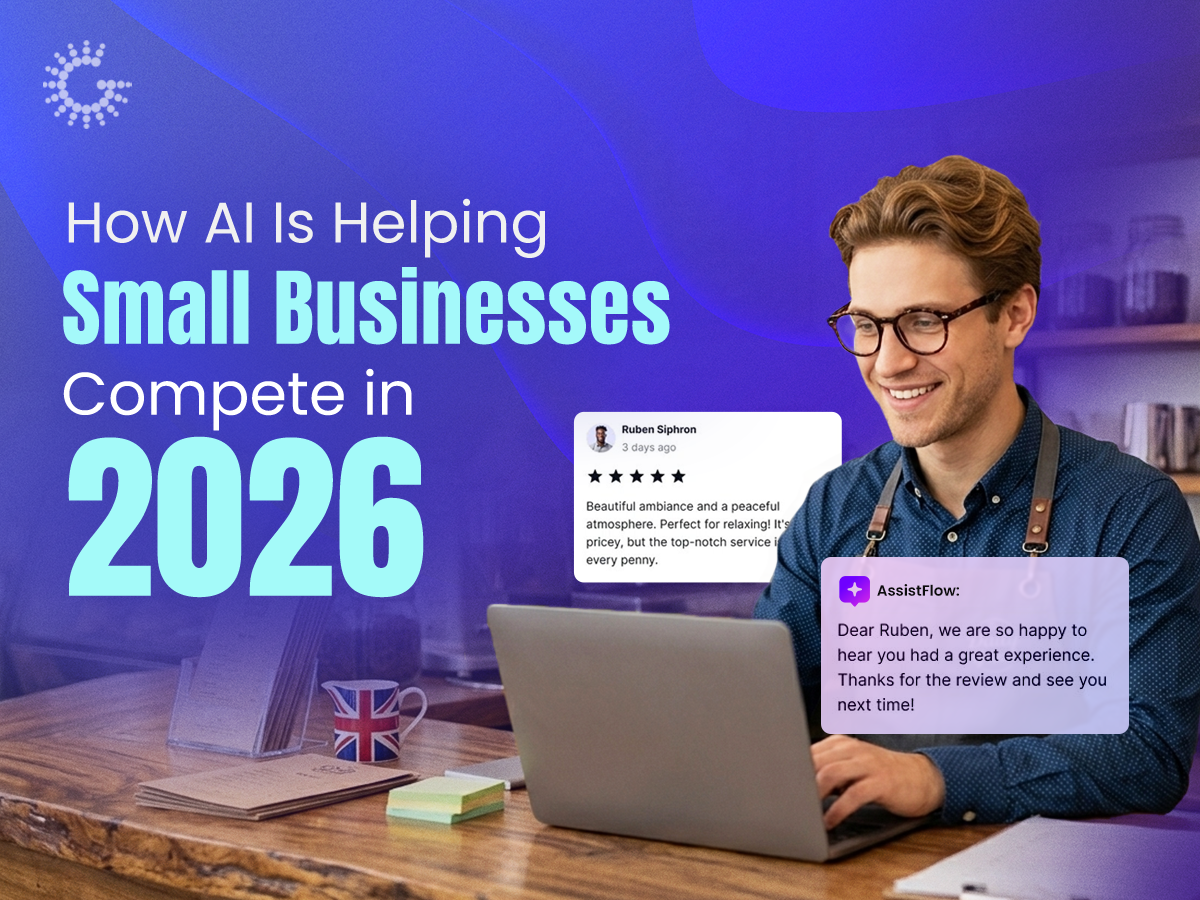
Big companies have always had some clear advantages over small businesses. They usually have larger teams, bigger budgets, more customer data, and more time to test new ideas.
Small businesses have had to do more with less. In many small companies, the owner or a small team handles sales, customer service, marketing, daily operations, and finance all at the same time. Even when a small business offers a great product or service, it can still be hard to keep up with bigger competitors that have more resources.
AI is starting to change this. It is giving small businesses access to tools and abilities that were once too expensive or too difficult to use. Below, we will discuss how small businesses can use AI to compete more effectively in 2026.
One common mistake small businesses make is thinking they have to copy large companies. They look at bigger competitors and feel they need to do everything those companies do. But this usually creates more pressure instead of real progress.
Small businesses do not need to act like big companies to compete with them. Instead, they need to use their own strengths. They need to become more focused, faster, more personal, and more useful to the customers they serve.
AI can help small businesses do this by focusing on what’s most important. A small business can use AI to:
This kind of focus is very important. A large company may have a bigger audience, but a small business can move faster. It can update its message quickly and respond to customer needs sooner.
When AI is used properly, it can make these natural small business strengths even stronger.
A business cannot compete well if it does not understand its customers. Many small business owners feel they already know their customers because they talk to them regularly. That experience is very useful, but it may not show the full picture.
Today, customer conversations happen in many different places. They may interact with a business through:
Before customers make a decision, they leave clues about what they want and what they need help with. These are hidden in the words they use.
AI can help small businesses collect, sort, and understand these clues more easily. For example, AI can:
This is helpful because customers do not always speak the same way businesses do.
A business may describe its service using professional and technical language. But a customer may describe the same need in a much simpler way. When a business understands the words customers actually use, its marketing becomes easier to understand.
This can improve website copy, social media posts, ads, product descriptions, and sales conversations.
When a small business listens more carefully, it can explain its value more clearly. That makes it easier for the right customers to understand why they should choose that business.
Marketing is one of the biggest areas where small businesses can benefit from AI. Many small businesses know they need regular marketing. But they do not always have enough time, ideas, or people to manage it properly.
AI can help small businesses:
Repurposing content can be especially useful. For example, one blog post can become several social media posts, email ideas, short video scripts, and FAQ content. This helps a business get more value from the work it has already done.
But AI should not turn marketing into a content factory.
Creating more content is not always the answer. Small businesses need useful content that answers real customer questions and helps people make decisions. AI should not be used to create generic posts that sound like every other business online.
For example, a local service business can use AI to generate content based on the questions customers ask before booking an appointment. An ecommerce brand can use the same AI to improve product descriptions and buying guides.
The best marketing that uses AI still needs human judgment. The business understands its customers best. AI simply helps organize that knowledge and turn it into content in the most efficient way possible.
Customer service is one of the most important areas for any small business. A fast and helpful response can make customers feel confident.
AI can help small businesses respond faster and stay more organized. It can:
However, customers still want to deal with real people in many situations. This is especially true when the problem is time-sensitive or too emotional.
A small business should not use AI to avoid customers. It should use AI to support better service. For example, AI can help answer simple questions about:
This gives the team more time to focus on customer problems that need personal attention.
AI can also help a business create better support resources. If customers keep asking the same questions, the business can turn those questions into FAQs or website content. This reduces redundant work for the team and improves the customer experience.
Small teams usually have to handle many tasks with limited time. This is where AI can deliver quick, practical value. AI can help with:
Many administrative tasks are necessary, but they take time away from more important work. When AI helps reduce this workload, small teams can spend more time on higher-value work. This can mean:
AI does not need to replace people to be useful. In many cases, its biggest value is helping people work with less pressure and more focus.
Many small businesses lose sales opportunities because their follow-up process is not strong enough.
For example:
These are common problems, especially when a small team is busy.
AI can help make sales follow-up more consistent. It can:
This is especially helpful for businesses that have a very small sales team or no dedicated sales team at all.
AI can also help small businesses understand why potential customers hesitate. If many prospects ask about pricing, delivery time, contract terms, setup, or results, address those concerns in the site content.
A strong follow-up system should make the next step for the customer simple. AI helps reduce the effort required to stay organized and responsive.
Search is becoming more competitive. Customers are now searching online before choosing to spend their money. This means small businesses need clear, helpful, and easy-to-find content.
AI can help improve search performance by helping businesses:
This is useful because many small business websites are too thin or too vague. They may explain what the business does, but they do not answer the questions customers ask before making a decision.
A website may list services, but it may not explain the process, pricing factors, timelines, benefits, or what customers can expect.
AI can help find these missing pieces.
For example:
AI can help create these content assets faster. But the business still needs to review everything carefully to make sure the information is accurate and written in the right tone.
Many small businesses collect useful data but do not fully use it. They may have website analytics, social media insights, customer reviews, sales records, and email performance reports. But this information is often scattered across different tools and platforms.
AI can help make sense of that information. It can summarize trends, identify patterns, and flag changes that may need attention. AI can help answer questions like:
This does not mean AI should make every decision for the business. Data still needs context. A number can show “what” happened, but the business still needs to understand “why”.
AI helps by making the first part of the analysis easier. Instead of spending hours manually reviewing reports, a small business can use AI to quickly identify where to start.
This gives the team more time to decide on the next action.
Better decisions are one of the strongest advantages a small business can build. When decisions are based on real patterns, marketing gets better. Customer service improves, too.
AI works best when it is connected to a clear business goal.
A business should know what it wants AI to help with. It may want to save time, improve customer service, create better content, increase leads, reduce manual work, or better understand customers.
Without a clear goal, AI can become just another distraction. The business may try many tools but not get real results.
AI can create content quickly, but speed can also create problems. If a business publishes AI-generated content without checking it, the content may sound generic, include mistakes, or fail to answer the customer’s real question. This can hurt trust.
An experienced writer should review every piece of AI-assisted content.
Automation can be helpful, but too much automation can make a business feel cold and distant. Customers can usually tell when every response feels robotic. If the business loses its personal touch, it may also lose the trust that helped customers choose it in the first place.
Small businesses should protect this advantage. Use AI for speed, structure, and simple tasks. Keep humans involved in moments where judgment is most important.
AI tools are everywhere now. It is easy for a business to keep adding new platforms because each one sounds useful. But too many tools can make work more complicated, not easier.
A small business does not need a large collection of disconnected AI tools. It needs a few useful systems that align with its actual workflow. Simple is better.
Start by looking at the tasks your team repeats every week. These may include writing similar emails, answering the same customer questions, preparing reports, summarizing calls, or creating basic content. Repeated work is a good place to introduce AI.
A small business should not try to change everything at once. It is better to start with one or two areas where AI can deliver clear improvements. This could be customer service, content planning, sales follow-up, or internal documentation. Once the business sees what works, it can slowly expand AI into other areas.
Teams need clear guidance on how to use AI. They should know what AI can help with and what must always be reviewed by a person.
For example, AI may be used for first drafts, summaries, topic ideas, and simple internal notes. But final client messages, legal claims, financial advice, medical claims, or sensitive customer communication may need human review.
AI can speed up content creation, but it should not make the brand sound generic. Small businesses should protect their tone and understanding of customers.
This is especially important because trust is one of the biggest strengths small businesses have. Customers may choose a small business because it feels more responsive to their needs. AI should support that feeling.
AI should improve the business in a way that is visible or measurable. If it is not helping, the strategy needs to change.
For this, a business can track simple signs such as:
The best starting point depends on the business. But some areas are especially useful for many small companies.
AI can help plan blogs, improve website pages, draft social media posts, create email campaigns, and repurpose existing content. This is very useful for small businesses that need more visibility but do not have a large marketing team.
AI can help answer common questions, summarize customer problems, and create support resources. This helps the business respond faster while reducing pressure on the team.
AI can support follow-up emails, lead summaries, proposal drafts, and sales notes. This helps small businesses stay consistent with potential customers and avoid losing good opportunities.
AI can help organize internal processes, prepare task lists, summarize meetings, and document workflows. This is especially valuable when teams are small and responsibilities overlap.
AI can help turn scattered information into useful insights. This supports better decisions around marketing, products, services, and customer experience.
A business does not need to work on all of these areas at the same time. The best approach is to start where the biggest problem is.
AI will continue to change how businesses work. More tools will include AI features as standard features of their platforms. Customers will also expect faster responses, accurate information, and more personalized experiences.
This will raise the standard for small businesses. Businesses that ignore AI may spend too much time on manual work while competitors become more organized and more responsive.
AI rewards businesses that know what they want to improve. It works best for companies willing to build better processes, use data more effectively, and stay focused on customer needs.
If your small business wants to use AI but does not know where to begin, the first step is to understand where AI can deliver the most useful improvements.
At TechGlobe IT Solutions, we help businesses build digital strategies that support real growth. Our team can help you find the right AI opportunities, improve your marketing systems, optimize your website, create better content, and build smarter customer journeys.
Talk to us today if you want to build a practical AI strategy for your business in 2026.
Small businesses can use AI for content creation, customer support, sales follow-up, data analysis, email drafting, task management, website improvements, and customer research. The best use of AI depends on the business goal. A company should first understand the problem it wants to solve, then choose AI tools that support that goal.
No, AI is not only useful for large companies. In fact, AI can be especially helpful for small businesses by reducing manual work and enabling small teams to work more efficiently. It gives smaller businesses access to tools and abilities that were once harder or more expensive to use.
Yes, AI can help small businesses with marketing. It can help plan content, write first drafts, improve website copy, create email campaigns, and turn a single piece of content into multiple formats for different platforms. However, AI-generated marketing content should still be reviewed by a human before publication.
AI is better used as a support tool, not as a complete replacement for employees. It can handle repetitive tasks, create first drafts, summarize information, and help teams work faster. But human judgment, customer understanding, creativity, and relationship-building are still very important.
The best first step is to look for repeated tasks that take up too much time. After that, the business should choose one area where AI can create a clear improvement. This could be customer service, content planning, sales follow-up, or internal task management. Starting small makes it easier to see what works.
Yes, AI can improve customer service. It can answer common questions, summarize customer issues, suggest replies, and help teams respond faster. However, complex, urgent, or sensitive customer situations should still involve a real person. AI should support customer service, not remove the human touch completely.
Small businesses should avoid using AI without a clear goal. They should also avoid publishing AI content without review, automating too much of the customer experience, using too many disconnected tools, and ignoring data privacy. AI works best when it is used carefully and with a clear purpose.
AI does not always have to be expensive. Many tools already include AI features, and some are affordable for small businesses.