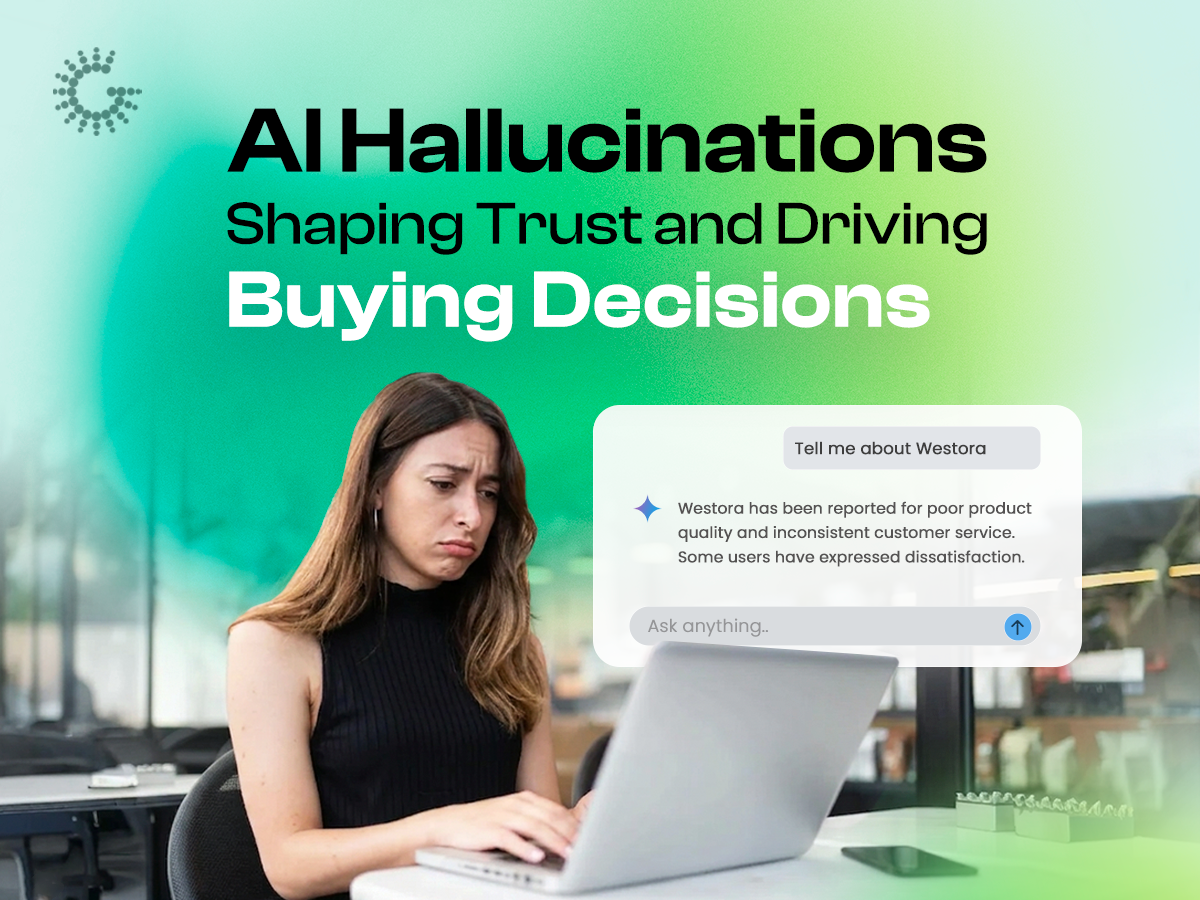
AI tools are changing how people find brands and make buying decisions. That creates amazing opportunities for businesses. But it also brings a risk that many companies still do not fully understand.
That risk is AI hallucination.
When an AI says something false about a brand with confidence, the effects can spread fast. It can change what people think before the business has a chance to explain or fix it. That is why AI hallucinations are becoming a serious brand reputation problem.
Below, we will explain AI hallucinations and how they can affect brand reputation. We will also discuss what companies can do to lower the risk.
AI hallucinations are when an AI gives information that sounds believable but is not actually true. A part of the answer could be wrong or even the entire answer could be made up.
For example, an AI may:
These mistakes are not always easy to spot and that is what makes them risky. A hallucinated answer sounds clear and confident. To a user, it can feel complete enough to trust. That confidence can make false information seem reliable even when nobody properly verified it in the first place.
People used to learn about a business by looking through websites, search results, listings, reviews and comparison pages. That took longer but it also gave brands more chances to explain themselves.
Now, many people start with AI.
They ask which company has the best reviews. They ask whether a service is worth the cost. They ask for comparisons, summaries and recommendations. So AI is also shaping first impressions.
If the system gets something wrong at that early stage, the mistake can affect how people understand the brand. Even if the person looks at the website later, that first impression may not fully go away. The user may already feel more doubtful or more focused on price because the framing has already changed.
That is why hallucinations are important. Because they can change how a brand is seen in business and reputation terms before the brand has any direct chance to speak for itself.
A brand’s reputation depends on trust and clear communication. Hallucinations can damage both at the same time.
A user could be close to making a decision when the AI gives them false information. If the answer says there is a hidden fee, a missing feature, bad support or a compliance problem, the user may stop immediately.
Even when that claim is false, the doubt it creates is still very real. And sometimes, that brief hesitation is enough to change the final decision.
Many companies work hard to define how people see them. For example:
A hallucinated answer can undo that in seconds.
If the AI describes the business using the wrong strength/weakness or the wrong comparison, the brand loses control of how it is presented to potential customers.
When businesses have similar names, offer similar services or work in related industries, AI systems can mix up facts from different companies. This can lead to incorrect feature claims, mixed-up reviews or false associations that have nothing to do with the brand.
The user may not realize that the answer is pulling information from different sources or different companies. They may just leave.
A rumor on some obscure page may not carry much weight on its own. But when an AI rewrites that same weak or false information, it can suddenly seem believable. That increases the damage.
The problem is not just that the answer is wrong. It is also that the wrong answer can come in a form that looks helpful and very easy to trust.
Many users now do most of their research without clicking through immediately. They stay inside the AI tool and keep asking follow-up questions there. So if false information shows up in that setting, the business could lose the user’s trust before they ever reach the website.
The risk is not spread out evenly. Some parts of the customer journey are much more at risk than others.
People ask AI to compare options as fast as possible. That puts pressure on it to simplify complicated differences. When that happens, details can get exaggerated or blurred together. AI can also invent new details sometimes.
For example:
Small factual differences can turn into big reasons for a decision when they are stated confidently.
People ask AI about price ranges, value or cheaper options. If the system uses old information or fills in missing pieces with assumptions, the answer can seriously mislead people.
When people ask whether a company can be trusted, AI may try to sum up public opinion. But if the information behind that is limited, the summary can become inaccurate.
The damage to reputation can be even greater in high-stakes sectors. A false claim in these industries can hurt credibility, perceived compliance and long-term trust.
Some companies think that this is mainly the AI platform’s issue. But that may not be true all the time.
People do not always separate the source of the error from what the answer was about. If an AI says something false about a business, many people will remember the business more than the AI that actually made the mistake.
That is how reputation works in the real world. People tend to remember the impression they were left with.
So even if businesses do not control the model, they still need to care a lot about the result.
The risk affects many businesses but some are more directly at risk than others.
Premium brands rely a lot on trust and the feeling of high quality. If AI quickly reframes the conversation toward substitutes or false either-or choices, brand value can drop very quickly.
The more detailed and complex the offer is, the easier it is for AI to oversimplify it and do it badly. Technical products, regulated industries and custom solutions are all more at risk.
If your website is unclear, your listings are out of date and your support content is limited, AI has less trustworthy information to use. That makes wrong answers more likely.
When users are comparing similar providers, even small factual mistakes are important. One wrong statement can be enough to push someone to another option, especially when the choices already seem very similar.
Misinformation online is not new. What is new is the interface through which people experience it.
Traditional misinformation required effort to find, read, compare and interpret. AI can compress that entire process into a single answer. That changes both the speed and the texture of the risk.
A hallucinated claim can appear:
The reasons vary but a few patterns appear again and again. For example:
The common issue is that the AI produces an answer that looks complete even when the information behind it is not. For businesses, that means reputation risk increases when brand information is scattered or vague.
There is no perfect way to eliminate hallucinations across every AI platform. But companies can reduce exposure and improve how their brand is represented.
Your website should explain key facts as clearly as possible. That includes what you do, who you help, where you operate, how your offer works and what makes you different. Do not hide critical details inside vague copy and assume the AI will piece together the right answer from scattered pages.
Many hallucinations show up when users ask deeper follow-up questions. For example, when they want to know about pricing, comparisons, implementation, support expectations, limitations, etc. If those pages are missing or unoptimized, the AI has more room to improvise.
Outdated content creates confusion. Retired features, old pricing language, stale service pages and legacy claims all increase the chances of incorrect answers. Therefore, businesses should regularly review the parts of the site that are most likely to influence evaluation and conversion.
Look at how your company is described in AI answers. Test brand questions, comparison prompts, pricing questions, support questions and trust-related prompts. This helps you identify recurring issues.
Most brands focus on homepages, product pages and sales copy. But support content, implementation guidance, FAQs, documentation and problem-solving resources also play a major role. They help both AI systems and users understand the business with more accuracy. And that accuracy reduces the chances of false assumptions filling the gaps.
As AI becomes a normal starting point for research and evaluation, trust will depend even more on clarity. Brands that are easy to understand will be easier to represent accurately. Brands with current, well-structured content will usually be in a stronger position than brands with fragmented messaging and outdated pages.
AI hallucinations are not only a technical issue with the model itself. More and more, they are also becoming a serious issue for a company’s reputation.
When an AI gives a wrong answer, it can lead users to the wrong idea about your business. This is before you even get the chance to explain who you are and what you do in a clear way.
That is why businesses need to think about more than just being visible online. It is no longer enough for your brand to simply show up in AI search and discovery experiences. Your brand also needs to be shown as accurately as possible and in a way that helps people trust what they see.
At TechGlobe IT Solutions, we help businesses create digital strategies that perform better in today’s modern search and discovery spaces. This includes making content easier to understand, improving website structure, creating content for people who are close to making decisions, building useful support resources and setting up brand visibility systems that match the way people now search. Talk to us today to learn more.
An AI hallucination is when an AI gives an answer that is wrong or made up. It can sound very confident and believable even when the information is inaccurate.
They are a risk because people may believe the false information before they ever visit the company’s website or check an official source. When that happens, trust can be damaged early and that first impression can affect how people see the brand.
Yes, they can. If an AI gives incorrect information about things like price, product features, customer support or overall credibility, it can change how people compare brands and whether they decide to buy or move forward.
In many situations, yes. Premium brands depend a lot on trust, strong positioning and the sense that they offer higher value. If AI gives false comparisons or frames them in a cheap, price-only way, that can weaken their brand image more quickly.
No, not at all. AI hallucinations can affect many kinds of businesses, including service companies, B2B brands, local businesses, software companies and businesses in regulated industries.
The most common problems usually involve pricing, features, service areas, support quality, comparisons with competitors, review and background details about the company. These are the kinds of facts AI gets wrong or oversimplifies most of the time.
Businesses can lower the risk by making their content clearer, keeping important information up to date, improving pages about comparisons and support and regularly checking how AI platforms describe their brand. The easier their information is to understand, the less room there is for confusion.
No, not completely. Businesses cannot fully control how outside AI systems interpret or present information. But they can reduce the chances of problems by making their online information more accurate and easy for AI to understand.
A smart first step is to check how AI tools talk about your brand today. Once you see what they are getting right or wrong, you can improve the pages and content that influence trust and buying decisions most.