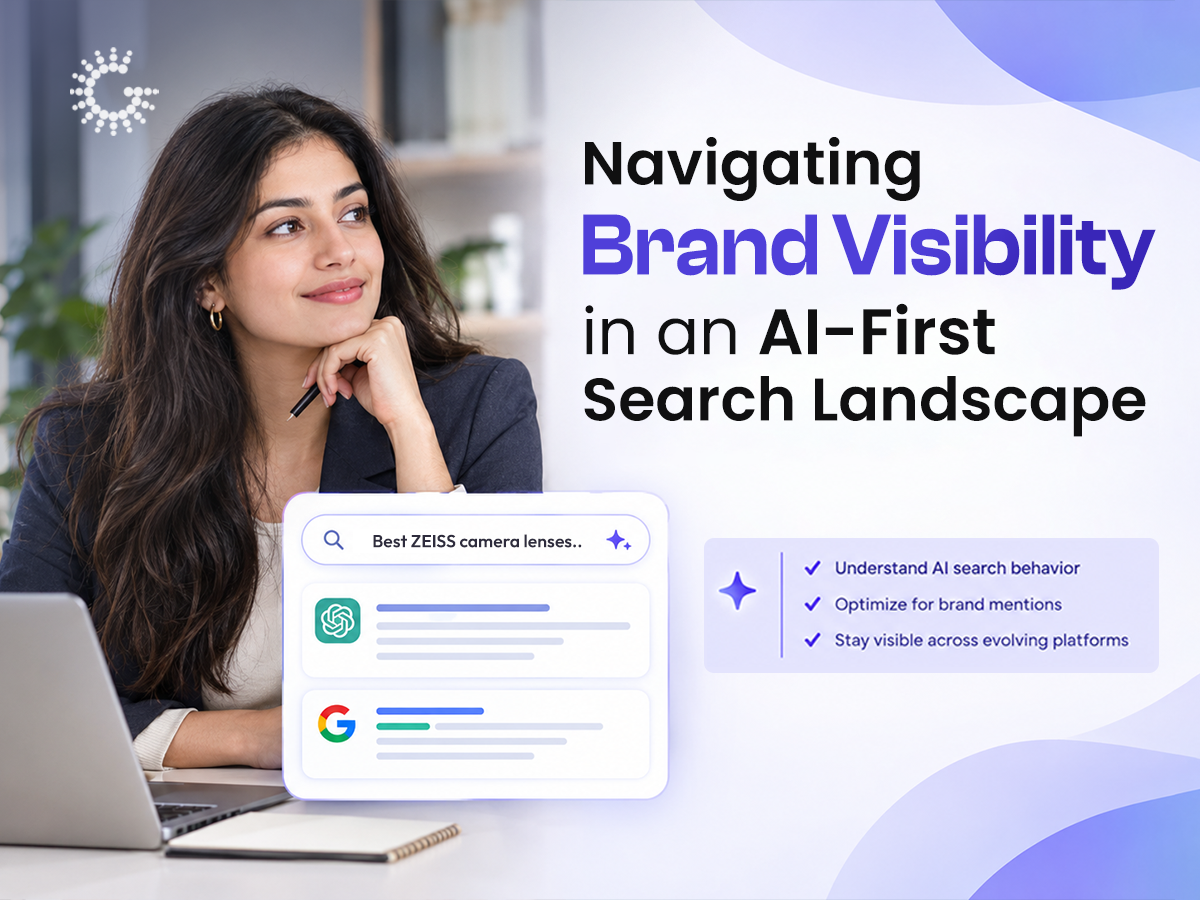
A customer needs software to manage inventory across an online store and several retail locations. Instead of opening product websites and reading comparison articles, they ask an AI assistant for recommendations. The assistant names four products, explains their strengths, and identifies one as the best fit. The customer starts researching those companies.
Your business serves exactly this type of customer. Your website ranks for relevant searches, and your product information is readily available. Yet your brand is absent from the response.
That’s the new challenge of brand discovery.
AI-assisted search brings product research and comparisons into the answer itself. A business with a visible website still faces the possibility of being left out when an unfamiliar customer first explores the market.
Traditional search presents people with links to explore. Someone choosing project management software visits company websites, reads independent reviews, and compares features before narrowing the options.
AI search offers another route. Google’s AI Overviews summarize information within search results. Google AI Mode supports a more conversational research experience. ChatGPT Search retrieves web information and provides answers with supporting links.
These products use different systems and present sources in different ways. But they share one important feature, which is that a customer gets an explanation or comparison without opening every website behind it.
For example, someone researching bookkeeping software asks which platforms handle multiple currencies, integrate with e-commerce stores, and suit a small team. An AI response brings those requirements together and presents relevant options. The customer encounters information about brands before reaching their homepages.
That changes the first impression. A company’s own website is no longer the starting point in every discovery journey. An AI-generated description sometimes introduces the business first.
Traditional search remains essential for navigation, deeper research, and transactions. AI-generated answers add another stage in the journey and influence which websites people choose to explore.
An accessible website gives search systems information to retrieve. It says little, by itself, about whether a customer notices the business in a generated answer.
Consider four different outcomes:
These outcomes overlap, but each describes a different type of exposure. None automatically establishes that a customer visits the website or buys the product.
Imagine a software company that publishes a detailed guide to inventory forecasting. An AI assistant cites that guide while explaining how retailers plan stock levels. The content receives attribution, but the response never names the business that published it.
The reader learns from the company’s material without necessarily recognizing its brand.
A June 2026 Semrush study recorded 3,981 domain appearances from 115 prompts across 14 countries and four AI search experiences: ChatGPT, Google AI Overviews, Gemini and Google AI Mode. In 61.7% of those appearances, the AI response included a source citation without naming the associated brand.
The study used a limited sample collected through Semrush’s tools. Its findings describe those tested responses. They don’t describe a universal rate across AI search. Still, the difference is instructive. A citation records source exposure, while a brand mention records explicit recognition within the answer.
Recommendations add another layer. An assistant discussing accounting software might name an expensive enterprise platform while recommending smaller products for a five-person ecommerce business. Each brand appears in the response, but only some enter the shortlist for that customer’s needs.
For businesses, the meaningful question is whether the right people encounter the brand as an option worth investigating. It is not how frequently its name appears in isolation.
Conventional search gives customers a collection of results to inspect. In some AI-assisted searches, the answer presents a shorter list of products or vendors. That shortlist draws attention toward the businesses it includes.
Consider two inventory software providers. Company A is widely recognized and appears in broad industry comparisons. Company B focuses on independent retailers with specialized multichannel features.
A customer asks an AI assistant for inventory software suited to a small retailer selling online and in physical stores. The answer’s selection varies with the platform, the available sources, and the wording of the question. One response highlights Company A. Another includes Company B. A third names both.
Absence from an individual response establishes only that the brand missed exposure in that particular answer. It provides no reliable verdict on product quality or SEO performance.
This distinction becomes important when a customer has never heard of the business. A person searching for a familiar brand already knows where to start. Someone exploring a category for the first time is building an initial consideration set. Inclusion in a relevant comparison gives a lesser-known company an opportunity to join that set.
AI recommendations are selective responses to particular questions. They are not complete rankings of every suitable business. Businesses still need to evaluate these answers in context instead of treating a single omission as proof of a larger problem.
Your website remains the primary source for explaining your products, customers, and distinguishing features. But customers also consult independent reviews, product comparisons, industry publications, and professional communities.
AI search draws on external information as well, with the mix varying across platforms and queries. This creates a practical challenge, where a company controls its own pages but has limited control over how other websites describe it.
Imagine an online retailer that recently improved its return policy. Its website describes the updated terms, while an older review still discusses the previous restrictions.
If an AI answer draws on the outdated review, it risks presenting a misleading account of the retailer’s current policy. This example is illustrative, but the underlying issue applies to service areas, product availability, software integrations, and other facts customers use to compare options.
Keeping first-party information accurate is the starting point. Businesses also benefit from correcting outdated directory entries, partner profiles, and other third-party descriptions where they have permission to make changes.
Independent information serves another purpose: customers want evidence other than a company’s sales pitch. A software vendor describes its product as easy to use. Reviews of onboarding, detailed product evaluations, and feature-by-feature comparisons offer additional perspectives. Those resources help customers assess the claim and sometimes appear among the sources AI search retrieves.
Semrush’s 2026 AI Visibility Index analyzed 126 million US AI search prompts collected from January through April 2026. It identified differences in how major platforms cited and mentioned brands.
The findings support a narrow conclusion that source and brand visibility patterns vary across AI search experiences. They do not establish that collecting more third-party mentions guarantees recommendations.
The practical priority is a reliable presence on websites customers actually use. Genuine coverage, relevant independent reviews, and accurate business profiles serve that goal better than manufactured endorsements or low-quality listings.
A customer who gets a useful answer inside a search interface has less reason to open every supporting website. Research offers evidence of this change in behavior.
In a July 2025 Pew Research Center analysis, researchers studied browsing activity from 900 US adults during March 2025. Users clicked a conventional search result on 8% of visits to Google results pages with an AI summary, compared with 15% of visits without one. Links cited within the AI summaries received clicks on just 1% of visits where a summary appeared.
The study was observational. It measured an association between AI summaries and clicking behavior. Its findings concern Google during the study period and not every AI search product.
Even with those limits, the business question is clear: what happens to brand discovery when some early research occurs without a website visit?
Imagine someone researching customer relationship management software. They read an AI-generated comparison, remember a product name and search for it directly several days later. Their analytics trail shows a branded search or direct visit, even though an earlier AI interaction introduced the company.
Now consider a different customer who reads a comparison, chooses a familiar competitor and never explores the other brands.
Both scenarios illustrate why AI visibility and commercial impact require separate measurement. A mention isn’t proof of new demand. A decline in organic visits isn’t proof that AI search caused it.
Organic traffic, rankings, qualified leads and conversions remain important. Brand mentions, citation exposure and accurate representation provide additional context. Together, these measures offer a more useful view than any one metric alone.
There is no proven method for guaranteeing recommendations across AI search tools. Start with improvements that make the business clearer and more useful to customers, regardless of their discovery channel.
Generic descriptions like “innovative solutions for businesses of all sizes” give prospective customers little reason to choose one provider over another. Compare that with a software company describing inventory management for small retailers selling through e-commerce platforms and physical stores. The second description identifies an audience, a problem, and a use case.
Review key product and service pages. State who the offering serves, which problems it solves, how it differs from alternatives, and where its limitations lie. Include relevant details like integrations, pricing structures, and service coverage.
Precise descriptions help buyers judge suitability and give search systems clearer information to retrieve. They improve the foundation for discovery without guaranteeing a place in an AI answer.
Broad educational articles have a place in content marketing. But customers comparing products need answers to more specific questions.
An online retailer choosing shipping software wants to understand carrier integrations, international fees, returns management, and the differences between pricing plans. A thoughtful comparison or implementation guide addresses those concerns directly.
Other useful resources include original research, transparent feature explanations, firsthand demonstrations, and documentation of real product limitations.
Google’s guidance on generative AI search emphasizes useful, original content and established SEO practices. It warns against treating special AI formatting or manufactured mentions as shortcuts to visibility.
Review your own product pages, service descriptions, and policies whenever offerings change. Then identify the external sources your customers rely on.
For software providers, that includes relevant review platforms and industry publications. For ecommerce brands, independent product reviews and retailer profiles deserve attention. The right mix follows the audience. Prioritize accuracy, genuine reviews and legitimate editorial coverage.
Search engines still need to discover, crawl, and interpret important pages. Keep navigation clear, content accessible, and internal links useful.
Google states that its generative search features rely on core Search systems. It requires neither an llms.txt file nor special AI-specific schema for eligibility. Structured data still serves established SEO purposes, including supported rich-result features.
Other platforms operate differently. OpenAI’s ChatGPT Search documentation explains its use of web search and supporting links. Website owners need to review crawler access according to the platforms they want to reach.
Technical accessibility is a prerequisite for some forms of retrieval and not a promise of citation or recommendation.
A useful comparison article attracts readers through conventional search. An independent review gives them a second perspective. A well-designed product page answers the final questions before purchase.
These activities reinforce one another whether the customer begins with Google, an AI assistant or a recommendation from someone they trust.
Treat AI search visibility as another part of that journey. Clear positioning, credible information and strong website content provide benefits across channels.
AI visibility reporting is improving, but different tools measure different outcomes. A useful measurement plan separates content exposure, brand recognition and commercial performance.
Google introduced a dedicated generative AI performance report in Search Console in 2026 and completed its global rollout on August 31. The report shows URL impressions in supported AI search features, including AI Overviews and AI Mode, alongside page and other reporting dimensions.
An impression records eligible exposure of a website link. It doesn’t establish that the customer noticed the brand, considered its products, or bought anything.
Microsoft launched AI Performance in Bing Webmaster Tools in February 2026. It reports citation activity, referenced URLs, and sampled grounding queries across supported Microsoft AI experiences.
A Google impression and a Microsoft citation reflect different activities. Keep them separate. Don’t present them as interchangeable measures of recommendations.
Alongside platform reports, select a consistent set of questions that prospective customers ask before choosing a provider. Include category searches, comparisons and specific requirements instead of focusing exclusively on questions containing your company name.
Review responses across a small selection of relevant AI search experiences. Record whether the brand appears, whether the description is accurate, what role it plays in the answer and which alternatives appear alongside it.
Run the same checks periodically. Because responses vary across sessions and platforms, use the results to identify patterns.
A practical review separates four questions:
The first three offer evidence about discovery. The fourth helps assess commercial value.
Review identifiable AI referral traffic, branded search trends, and customer answers to questions about how they first heard of your company. These measures have limits: customers use several channels during a purchase, and some AI-influenced interactions leave little trace in standard analytics.
Use the patterns to guide investment, without claiming precise revenue attribution from incomplete data.
The biggest change isn’t simply the prospect of fewer clicks on informational searches. It’s the shift in where customers form their first impressions and narrow their choices.
In some research journeys, an AI-generated comparison becomes an early filter. The companies included receive attention, while relevant businesses left out lose an opportunity to introduce themselves.
A strong response starts with the fundamentals:
Individual AI answers offer clues, not definitive judgments about a brand’s market position.
AI search adds another way for people to discover and evaluate businesses. Clear positioning, useful content, and accurate brand information strengthen the experience whether customers begin with a conventional search result, an AI-generated comparison, or an independent review.
TechGlobe IT Solutions provides SEO, content marketing, and related digital marketing services that support those foundations. To discuss your website, brand visibility, and customer acquisition priorities, contact TechGlobe IT Solutions.
Search-enabled AI systems retrieve information from accessible sources about businesses of different sizes. Smaller brands improve the information available about them by maintaining clear websites, accurate profiles, and credible independent coverage. Inclusion varies by question and platform, and no company receives a guaranteed recommendation.
A traffic decline alone identifies no single cause. Search demand, competition, seasonal patterns, technical problems, and changes in search results all affect traffic. Compare those factors with conversion trends and any available AI visibility data before concluding.
Start with reliable website content, technical accessibility, and accurate information across relevant sources. Then review the documented requirements and reporting tools for platforms important to your audience. Treat platform-specific techniques as tests instead of universal best practices.
Google requires neither an llms.txt file nor AI-specific schema for its generative search features. Conventional structured data remains useful for supported Search features, but it gives no guarantee of an AI citation or recommendation. Requirements elsewhere vary by platform.
Google offers verified website owners a Search generative AI control in Search Console. The control manages inclusion in supported generative AI features without removing ordinary Google Search listings. Exclusion also gives up the related opportunity for AI-feature exposure and traffic.
There is no universal update schedule. Timing varies with the platform, its retrieval process, and the sources it accesses. Correct outdated information on your website and authorized external profiles, then review responses periodically. Publishing an update provides a better source of information without guaranteeing immediate changes to generated answers.
