A customer looking for a dentist might once have searched ‘best dentist near me‘ and opened several websites to compare the options. Now they can ask Google AI Mode, Ask Maps, or ChatGPT something far more specific: ‘Which nearby dentist has good reviews, evening appointments, and experience with anxious patients?‘
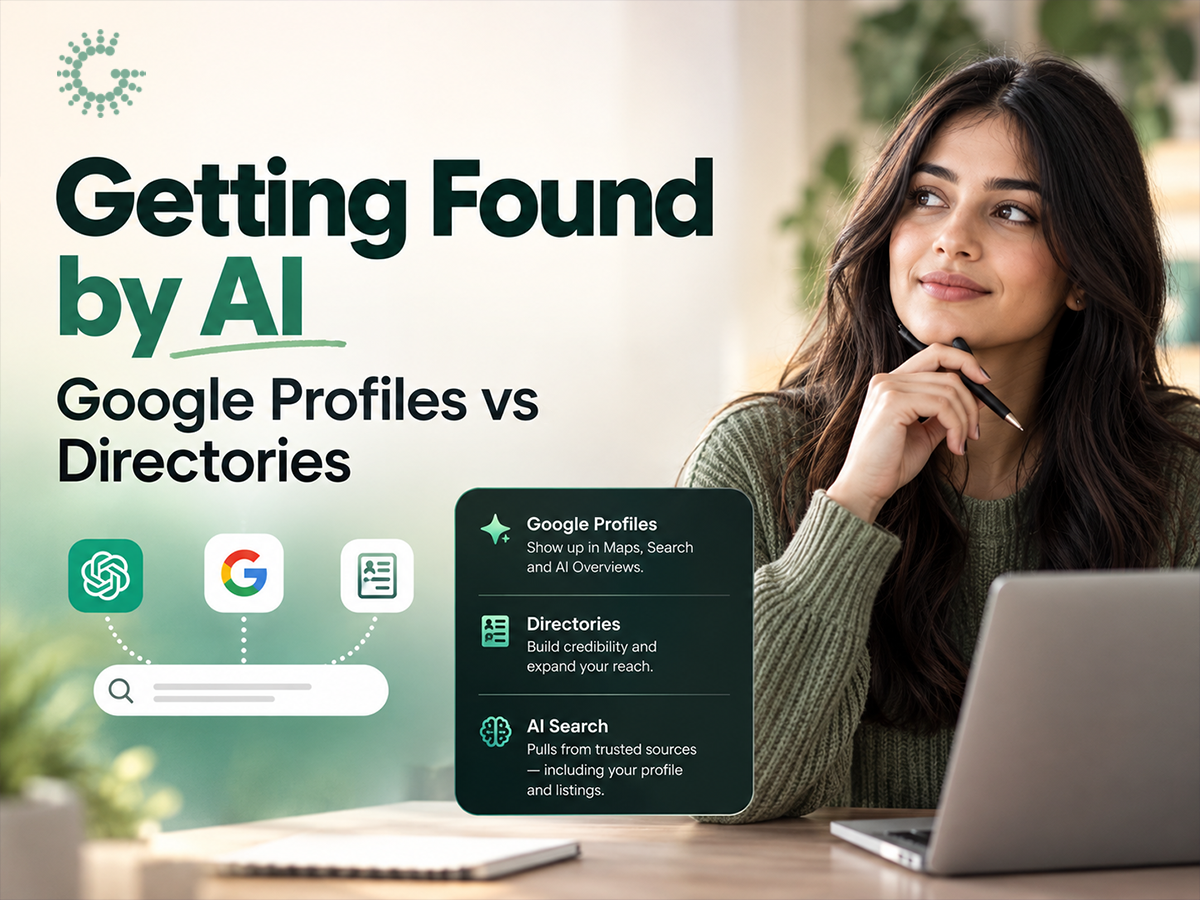
AI search can pull details from several sources and compare businesses before a customer clicks through to any of their websites. So, which is more important for AI visibility: Google Business Profile or business directories?
Google and non-Google AI systems rely on different mixes of local business data. Inside Google Search and Google Maps, Google Business Profile is the stronger foundation. Across ChatGPT and other AI discovery tools, third-party directories can have a larger role because those systems draw from a wider range of web sources.
Most local businesses need both. The question is where to focus first.
Traditional local search usually meant entering a service query, scanning map results, and clicking through to learn more. Someone might now ask for a nearby restaurant that is open late and has vegetarian options. The same type of query works for an emergency plumber serving a particular neighborhood or a provider that meets several requirements at once.
Google supports these conversational local queries through AI Mode, AI Overviews, and Ask Maps.
AI Mode and AI Overviews use Google’s search systems to retrieve relevant information. Ask Maps uses Gemini with Maps data to answer questions about places conversationally. Ask Maps can analyze information from more than 300 million places, including reviews from its global contributor community.
ChatGPT can also search the web for current local information. ChatGPT Search may use third-party search providers and trusted data providers, with general location information used to improve nearby results.
There is no single local-business database controlling visibility across every AI platform.
For businesses that depend on Google discovery, Google Business Profile should come first.
Business Profile information helps surface relevant local results across Search and Maps. A profile can include your business name, address, phone number, hours, website, categories, services, photos, and reviews. Complete and accurate information makes a business more likely to appear in relevant local results.
Those details become especially relevant when a query combines several criteria. Services, service areas, opening hours, and other profile information give Google data it can match against a customer’s request.
BrightLocal’s 2026 citation study points in the same direction. The company analyzed about 1.9 million citations for 1,355 business locations in the US, UK and Australia across Google AI Overviews, Google AI Mode and ChatGPT. Google Business Profile accounted for roughly 28.5% of citations overall and was the dominant source for Google’s own AI experiences.
That does not mean every Business Profile field is a confirmed AI ranking factor. Google does not publish a formula assigning AI ranking weights to categories, photos, profile updates or individual fields. But if customers find your business through Google, leaving the profile incomplete or outdated gives Google less reliable information to work with.
Some directories now appear regularly as sources in AI search results. The sources vary noticeably from one AI assistant to another. One platform may rely heavily on business websites, while another may cite listings, reviews, or third-party platforms more frequently.
BrightLocal’s 2026 research found 415 directories appearing as sources in local AI results. Yelp was especially prominent in ChatGPT results within its dataset. TripAdvisor, Better Business Bureau, MapQuest, Angi and industry-specific sites also appeared.
Yext reported similar findings in a much larger dataset. Its analysis of 155.5 million location-grounded AI citations found that 80% pointed to brand websites or listings, both of which businesses can influence. The sources cited were not distributed the same way across the AI platforms it studied.
This is not a reason to submit your business to hundreds of directories. Focus on platforms that customers in your area or industry actually use and keep those listings current. For a restaurant, that might include TripAdvisor or OpenTable. A law firm may care more about established legal directories, while home-service companies are more likely to benefit from contractor and service marketplaces.
The balance changes depending on where customers are searching:
If resources are limited, get your Google Business Profile right first. Then add the directories that matter most in your market rather than trying to maintain listings everywhere.
Check your business name, address or service area, phone number, website and hours. Choose the correct categories, list the services you currently offer, add applicable profile attributes and use recent photos of the business.
Local results are primarily based on relevance, distance and prominence. Complete information helps Google understand when a business is relevant to a search.
Start with the general directories customers in your area actually use, then add established platforms for your industry. Look at where competitors are listed, which sites customers rely on and which sources appear in AI answers for searches related to your category. Citation patterns vary by platform and industry, so no directory list makes sense for every business.
Your business name, address, phone number, website, hours, and service information should not conflict across different sources. Profile information can be compiled from a business’s website, licensed third-party data, user contributions, and information supplied by business owners. Google may also update profile information when other sources suggest that existing details are outdated.
This does not prove that exact NAP consistency is a direct AI ranking factor. Consistent information still reduces the chance that platforms encounter conflicting details about your business.
State your services and service areas directly. If you operate several locations, give each one enough information to stand on its own. Core details like services, locations, and opening hours should appear as readable page text rather than being communicated only through images.
Existing SEO best practices remain relevant for AI Overviews and AI Mode. Google also recommends keeping Business Profile information current and ensuring that structured data matches the content visitors can see on the page. LocalBusiness structured data can identify details like an address and opening hours in a machine-readable format.
Ask customers for reviews on the platforms that are relevant in your category and reply to those reviews as you normally would. Avoid purchased reviews, review gating and unnatural requests stuffed with target keywords.
Do not judge AI visibility by searching your business name once. Use the kinds of questions a prospective customer would genuinely ask across Google Search, Google Maps and major AI assistants. Note which businesses appear and which sources the answer cites.
Yext’s September 2026 study tested the same local queries across four major AI engines and found substantial disagreement in the businesses they recommended.
For Google Search, Google Maps, and Google-powered local discovery, Google Business Profile matters more. Outside Google, directory coverage becomes more relevant because different AI assistants consult different web sources.
Fill out the Google profile with the information customers need. Keep important directory listings current. Put service, location, and contact information where visitors and search systems can easily find it. Then periodically repeat customer-style searches on the AI tools that matter to your audience and see where the business appears.
Want to improve your visibility across Google and AI search? Talk to TechGlobe IT Solutions.
For visibility in Google Search and Maps, start with Google Business Profile. On ChatGPT and other AI assistants, third-party directories become more relevant because the source mix goes beyond Google.
Business Profile information can come from public web content, licensed third-party data, user contributions, and business owners. Third-party sources can therefore contribute to the information Google maintains about a business, although that does not make every directory a direct ranking factor.
Yes. Directory listings can appear among the sources ChatGPT uses for local information. ChatGPT can search the web and use third-party providers. Research has also found directories appearing frequently in local ChatGPT citations. A listing still does not guarantee that a business will be recommended.
Consistent names, addresses, and phone numbers reduce conflicting business information. Exact NAP consistency, however, should not be presented as a confirmed direct AI ranking factor.
Not necessarily. Standard SEO fundamentals still apply to Google AI Mode and AI Overviews. For those Google experiences, local businesses do not need a separate technical playbook beyond established SEO fundamentals. For broader AI discovery, it still makes sense to maintain a solid website, keep your Google Business Profile accurate, stay current on key directories and earn genuine customer reviews.