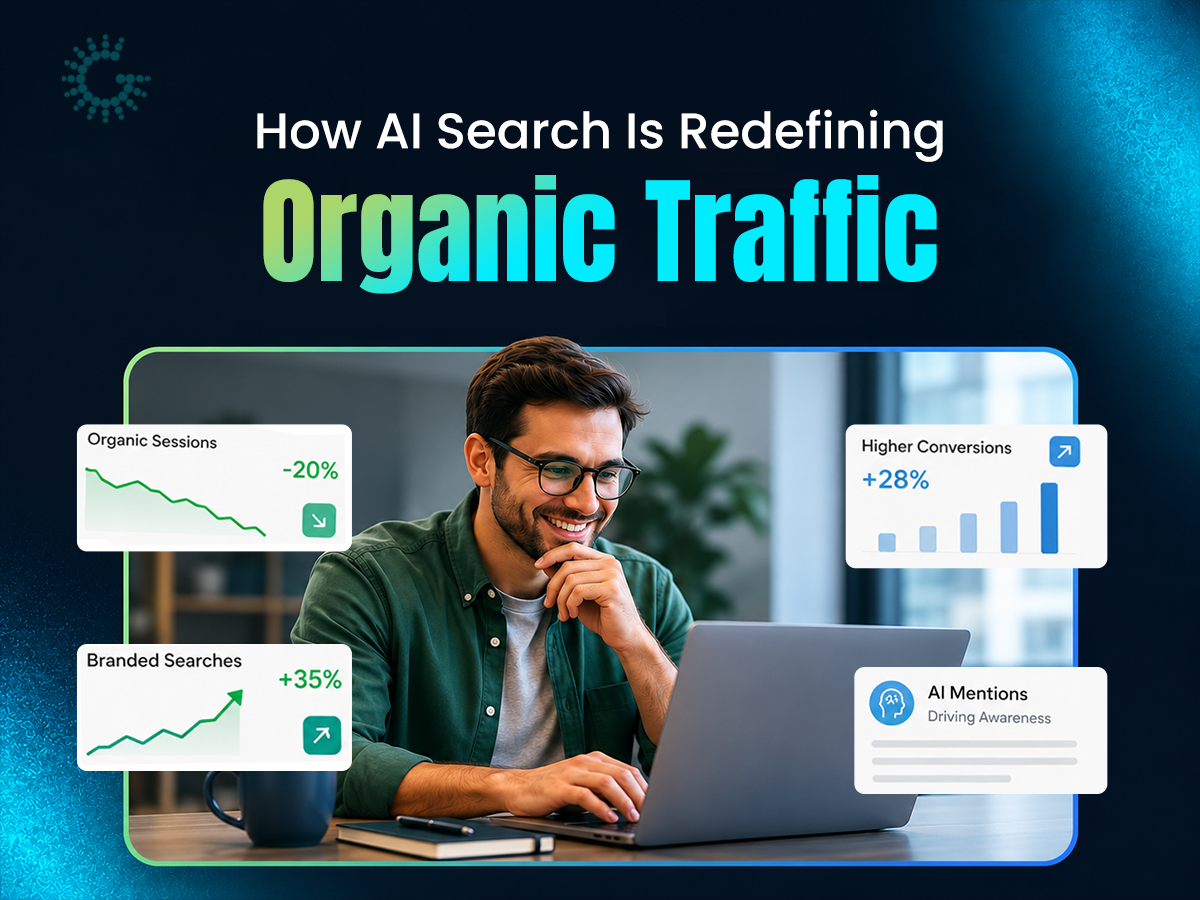
Imagine opening an SEO report and seeing organic sessions down 20%. That would traditionally look like bad news. You may assume rankings have slipped or competitors are taking a larger share of available clicks.
But the rest of the report then tells a different story. Branded searches are rising, the visitors who do reach the site are converting at a higher rate, and more prospects seem to know the company before they arrive. Some are searching for it by name after AI-generated comparisons mention it.
So did organic performance actually decline? That is becoming harder to judge.
Website traffic is still important, but organic traffic only records what happens after someone clicks. AI search can influence a customer before that click ever happens.
Say someone discovers a company in a Google AI Overview, compares it later in ChatGPT, then searches for the brand by name several days later and converts. Analytics records the eventual visit, but it may never record the interaction that first created the interest. That gap is changing what organic performance means.
Organic traffic is becoming a more specific measure of website visits, while organic search is becoming a broader influence channel that can shape discovery and demand before a session ever appears in analytics.
The two still overlap, but they are no longer interchangeable. You should look at what organic traffic used to capture to understand why that is important.
Organic traffic has traditionally meant unpaid website visits generated by search engines. Someone searches, clicks a non-ad result, lands on a website and analytics attributes the session to organic search.
That model worked reasonably well when more of the research process happened after people reached the website. Traffic could therefore act as a rough proxy for both search visibility and demand.
Marketers could usually infer that the business was gaining visibility, earning more clicks, or both, if organic traffic grew. Traffic was never a perfect measure of SEO success, but it captured much of the value search created for a long time.
Consider a search such as: “Best CRM for a 30-person manufacturing company.”
A conventional search like that could once have created several website sessions. A buyer could read a comparison article, visit a vendor page, leave, then return later to search for more information. An AI-powered search can compress much of that work into a single interaction.
AI search aims to handle nuanced questions and complex comparisons. It can use query fan-out, meaning it runs multiple related searches across different subtopics before producing an answer.
ChatGPT search reflects a similar change in how people search. It can look across the web, combine current information and provide links to relevant sources without requiring the user to open several websites first.
The important change is not simply that AI can answer questions. Search engines have been doing that for years through featured snippets and knowledge panels. What has changed is how much research can happen before someone leaves the search interface.
An AI interaction can help a buyer define a problem, compare options, narrow a shortlist and ask follow-up questions about specific concerns. Work that used to happen across several sites can now happen inside the search experience itself. And this is already happening at an enormous scale.
Google said AI Overviews had more than 2.5 billion monthly active users and AI Mode had passed 1 billion in May 2026. Google also reported that AI Mode queries had more than doubled every quarter since launch.
That changes the question businesses need to ask. Businesses can no longer ask only whether search sent a visitor. They also need to know whether search influenced what that person considered and eventually chose. The effect becomes easier to see when we look at what is happening to clicks.
The clearest effect of AI-generated answers is traffic compression. People can now complete some searches without visiting a website, even though those searches once required one, and the available research so far points in that direction.
Pew Research Center studied the March 2025 browsing behavior of 900 U.S. adults. Users clicked a traditional search result in 8% of visits with an AI summary, compared with 15% of visits without one. Only 1% of visits with an AI summary led to a click on a source that the summary cited. People were also more likely to stop browsing after seeing an AI summary. That happened in 26% of visits with a summary, compared with 16% without one.
Ahrefs reached a similar directional conclusion using a different method. Its February 2026 study examined 300,000 keywords using aggregated Google Search Console desktop CTR data from December 2025. Ahrefs estimated that the top-ranking page had a 58% lower average click-through rate than its modeled counterfactual when an AI Overview appeared.
Broader zero-click research points in the same general direction. SparkToro used Similarweb clickstream data and estimated that 68.01% of U.S. Google searches from January through April 2026 ended without a click. That analysis covered desktop and mobile-web behavior, but it did not include searches inside Google’s mobile search app. SparkToro also warns against treating the figure as directly comparable with earlier zero-click studies because the panels and methodologies differ.
Those findings can collectively make it seem as though Google is simply eliminating organic traffic. The evidence is not that simple.
Google said in August 2025 that total organic click volume from Search to websites had remained “relatively stable” year over year. It also said the number of what it calls “quality clicks” had increased slightly. Google defines those as visits where users do not quickly return to the search results.
Alphabet said Google’s AI-powered Search features were sending billions of clicks to websites every week in July 2026.
Those statements do not cancel out the Pew or Ahrefs findings because they are looking at different parts of the system. Some informational queries can suffer steep CTR declines while total search activity keeps growing. An individual website can also lose traffic even if Google’s total outbound click volume remains high.
A more useful conclusion is that search engines are becoming more selective about which parts of the customer journey still require a website visit. The value of the remaining clicks grows when fewer clicks are available for some types of search.
Website visits are not equally valuable, so a lost click does not always mean lost business value.
Compare these two searches:
An AI-generated answer can satisfy much of the first query without sending anyone to a website. A cybersecurity company could therefore lose a large amount of traffic from definition pages without losing an equal amount of commercial demand.
The second query is different because the buyer is already comparing options and trying to decide. Trust is a bigger factor, and an answer that includes a company can affect which companies make the shortlist.
That creates a pattern marketers are likely to see more regularly: fewer visits, but more concentrated intent among the people who still visit. Early referral data supports that possibility.
Semrush analyzed billions of visits across more than 50,000 websites in 17 industries. It found that AI referral traffic grew 66% during 2025, although it still accounted for less than 0.15% of total visits in its dataset. Semrush defined AI traffic as referrals from AI-powered tools, while Semrush measured Google AI Mode separately. Organic search remained much larger.
So AI referrals have not replaced traditional search as a traffic source. People arriving from AI interfaces may still be further along in their research.
Similarweb reported that generative-AI referrals to U.S. transactional sites converted at about 7%, compared with roughly 5% for Google referrals. Its analysis also found stronger engagement from AI-referred visitors.
That does not prove a universal conversion advantage. Results can still vary by industry and device. What it does show is why session counts alone can hide commercial value.
AI can remove a visit by answering a question directly, but it can also send fewer people who arrive with much more context. And some AI influence never shows up as an AI referral in the first place.
The most consequential AI-search traffic may be traffic that analytics never labels as AI traffic.
Similarweb examined this attribution gap using U.S. desktop journeys from July through December 2025. The study focused on users who received a ChatGPT brand recommendation without having recently visited that brand. Users who saw a recommendation were 2.5 times more likely to visit the recommended brand within the following seven days than the relevant comparison group. Similarweb also found that 55.9% of AI-influenced visits arrived through search, rather than through a direct AI referral.
Consider a buyer looking for commercial solar installers. The buyer asks an AI assistant for recommendations, sees the assistant name a company in the response, but does not click. That buyer searches for the company’s name on Google and visits the site two days later. Analytics records an organic branded visit, but it may have no record of the AI interaction that created the interest in the first place.
Some traffic that looks like ordinary organic traffic may therefore be downstream AI-influenced traffic.
Traditional attribution has always missed part of the earlier customer journey, but AI makes the problem more visible because a recommendation can create demand without creating a referrer.
The first touch can disappear from the analytics trail completely. That becomes even more important as AI moves beyond simple informational search and into commercial consideration.
Marketers would be mistaken to assume AI is only useful for basic informational queries. Current research suggests its role is expanding further into comparison and buying research.
Semrush studied more than 600,000 U.S. desktop keywords across 10 industries between November 2025 and April 2026. The share of commercial-intent searches triggering AI Overviews increased by an average of 71% during that period, while the share of transactional-intent searches triggering them fell by 5%.
Commercial queries involve research and comparison, while transactional queries happen closer to the final action. That makes AI particularly useful in the space between initial awareness and purchase.
A customer could ask “A versus B,” then follow with a more specific question about which option fits a certain use case. Those exchanges can decide which brands remain under consideration long before the customer visits a website.
This changes what it means for marketers to win. The goal is not always to get the click immediately after the query. The real win sometimes comes from an answer that includes the brand and determines what the customer searches next. Marketers need to treat search visibility and search traffic as separate things once that happens.
Traffic once worked as a rough proxy for search visibility because more people clicked what they saw. That shortcut is becoming less reliable. A URL can appear inside an AI-generated experience without receiving a visit, and an AI-generated answer can recommend a brand without producing an immediate click at all.
Google’s measurement tools now reflect that difference more directly.
Google launched dedicated Search Generative AI performance reports in Search Console on June 3, 2026. The reports show how frequently URLs from sites in the rollout appear in generative AI features and include dimensions such as pages and countries. Search-device data and date-based reporting are also available. Google says those impressions remain part of overall Search performance data, while the new reports provide a separate view of generative-AI visibility. That gives businesses a clearer distinction between visibility and visits.
Visibility in AI Search can be an outcome even when it does not immediately produce a session.
That does not mean every impression has business value. An impression is not revenue, and a citation is not a lead. But visibility is not automatically meaningless just because someone did not click at that moment. The practical response is to treat traffic as one part of a broader scorecard.
Replacing organic traffic with a fashionable “AI visibility score” would not solve much, because neither measure gives a complete picture on its own.
Businesses need to look at organic performance across several levels:
The point is not to build a dashboard that contains dozens of metrics nobody uses. It is to stop asking organic sessions to answer several different questions at once.
Are people discovering the business? Is it entering the consideration set? Are the right people reaching the website? Is that visibility contributing to revenue?
Traffic directly answers only the website-visit part. Businesses need other demand signals to understand what happened before the visit, and that makes branded search more important than it used to be.
SEO teams have traditionally separated branded search from non-branded SEO because someone searching a company’s name already knows the brand. AI complicates that assumption. A later branded query may represent demand created by AI discovery if an AI system introduced the company.
That means businesses should pay closer attention to searches such as “Brand + reviews” and “Brand + pricing.” Queries involving alternatives or competitors can provide another useful signal. Those searches may show that people are leaving an AI interface with enough awareness to seek the company out deliberately.
Businesses should not credit every increase in branded search to AI. Advertising can create branded demand, as can PR and other channels that analytics may not identify cleanly.
The more useful signal is the relationship between branded demand and AI visibility. Branded demand and AI visibility warrant investigation when both rise together. This shift also changes what kind of content has the best chance of holding its value.
A page whose main value is a short, generic explanation is much easier to replace than it used to be. An AI system can synthesize that information without sending users to every source when many websites publish the same basic definition.
Content becomes harder to replace when it contains something distinct. Original research can do that. First-hand expertise can do it too. Detailed product information, useful tools and evidence that is hard to find elsewhere all give people a reason to visit the source rather than stop at the summary.
Google’s 2026 guidance for generative AI search makes a similar point. Google recommends creating valuable, unique, non-commodity content. It also says established SEO practices remain foundational because its generative Search features rely on core ranking and quality systems.
That suggests a simple test for content planning: What reason remains for a user to visit us after receiving a two-paragraph AI summary of this page?
The answer may be no for many generic SEO pages. Some of those pages need stronger evidence or a proprietary perspective. Others may need interactive functionality, more detailed product information or clearer commercial value.
The goal is not to stop AI from summarizing the page. The goal is to make the source useful enough that people still want to consult it. And claims on the company’s own website cannot support that usefulness on their own.
A company cannot prove its reputation entirely through what it says about itself. A brand may describe itself as a market leader while independent coverage suggests otherwise. A software vendor may claim enterprise fit while reviews consistently show that smaller teams are a better match.
That wider information environment is crucial because AI systems can draw from sources well beyond a company’s own domain.
Digital PR and expert commentary can strengthen the external evidence around a brand. Credible reviews and customer proof can support it as well.
The goal should not be to manufacture mentions to “trick the LLM.” That would simply recreate the same low-quality tactics that have repeatedly damaged search marketing. A stronger approach is to build a digital footprint where independent sources can corroborate important claims about the business. A company that wants AI systems to associate its brand with a category needs credible evidence of that association beyond its own landing pages.
AI search has introduced new labels, including AEO and GEO. People also use LLMO for the same emerging area. The terminology is new, but the technical foundations of discoverability are not.
Google states that AI Overviews and AI Mode impose no additional technical requirements beyond the relevant Search eligibility requirements. A page still needs to meet Google’s indexing and snippet-eligibility requirements. Google also says these AI features require no special schema.org markup, and websites do not need separate AI text files to qualify. Crawlability and indexation are still crucial, as are internal linking and useful textual content. Structured data remains relevant when it accurately matches visible page information.
OpenAI says any public website can appear in ChatGPT search results. Site owners can help OAI-SearchBot discover and cite their content by allowing it.
AI visibility therefore makes more sense as an extension of search strategy than as a replacement for SEO.
The technical layer still makes discovery possible. The harder problem is measuring what happens after discovery.
Marketing attribution has never been as exact as most dashboards make it look, and AI search makes those limits harder to ignore.
A customer journey now looks more like this: AI comparison with no click → later branded Google search → direct visit → conversion.
Which channel created the customer? No mathematically perfect answer exists.
Google Analytics’ AI Assistant channel improves measurement of direct referrals from AI services, but it does not solve the no-click influence problem. Businesses will therefore need to piece together evidence from several sources.
Analytics and Search Console can show behavior on owned and search surfaces. CRM outcomes can reveal what happens later, while branded-search trends can show whether demand is growing around the company name.
Customer surveys and assisted-conversion analysis can add another view.
One simple question is still useful for high-value sales: “Where did you first hear about us?”
The answer will not always be precise, but first-party customer feedback can reveal patterns that analytics misses. The goal should not be to recover every lost click once attribution becomes less certain. It should be to focus on the interactions that carry meaningful business value.
Some clicks are disappearing because the search interface can answer the question efficiently without sending the user anywhere else. Trying to recover all of them is unlikely to be productive.
Businesses should start by identifying informational pages that generated high traffic but little business value, then separate those from research queries that influence serious buying decisions. They should also pay attention to whether the brand appears when customers compare alternatives, because those moments may shape the shortlist even when they do not produce an immediate visit.
Content deserves more investment when proprietary evidence or genuine expertise gives users a reason to move beyond the AI summary.
The website’s role changes as well. Visitors may arrive with more specific and more advanced questions if AI handles more of the basic education at the beginning of the journey. Product and service pages may therefore be more important, along with case studies and pricing information.
The website no longer needs to introduce the topic from the beginning. It increasingly needs to prove the choice. That leads to a broader definition of organic success.
Many marketing teams react to a new channel by creating a new headline metric, but AI search is unlikely to fit neatly into one number. Traffic and rankings are still major factors. Citations are important too, along with branded demand and AI mentions. Marketers should not interpret any of them alone.
The broader objective is organic influence.
Organic influence looks at how unpaid digital discovery builds awareness and consideration for a business, then asks whether that influence eventually brings people to the business and helps them choose it.
That influence sometimes produces an immediate click. It sometimes produces a branded search several days later and sometimes puts a company on the shortlist without creating a website visit at that moment. That is why marketers can no longer treat a decline in organic sessions automatically as an equal decline in organic performance.
Lower traffic sometimes really does mean the business is losing visibility. In other cases, low-value clicks shrink while visibility remains strong. Click-through behavior will also change in some cases, while branded demand or qualified leads reveal influence later.
The job of modern organic measurement is to work out which of those patterns is actually happening. Once teams identify which pattern is happening, organic strategy can focus on the outcomes search now creates rather than the traffic patterns it created in the past.
AI-powered discovery is not removing the need for websites or SEO. It is changing where people consume information, how much research happens before a visit and when they decide to click. AI-powered discovery is also making the connection between discovery and revenue harder to observe.
Businesses that evaluate SEO almost entirely through traffic can now misread both losses and opportunities.
A stronger approach connects technical SEO with AI-search visibility and links authority building to conversion performance. Looking at those signals together gives businesses a better view of organic growth than traffic alone.
TechGlobe IT Solutions helps businesses build that wider view. We can help strengthen search visibility, improve technical SEO, reshape content around higher-value customer journeys or assess how AI discovery is affecting performance. Talk to TechGlobe IT Solutions today to build an organic strategy around the way search is actually evolving.
AI search is already reducing organic website traffic for some searches. Pew Research Center found that users clicked traditional search results less when a Google AI summary appeared, while Ahrefs estimated a substantial modeled CTR reduction for top-ranking pages on keywords with AI Overviews. The effect is not uniform, though. Google says its aggregate organic click volume has remained relatively stable.
Yes. Google says its generative Search features rely on core Search ranking and quality systems, so technical accessibility and useful content remain fundamental. AI changes how people consume search information, but it does not remove the need for that information to be discoverable and trustworthy.
AI search visibility describes how prominently a brand or website appears in AI-generated discovery experiences. That may include a citation, a brand mention, or visibility in features such as Google AI Overviews or AI Mode.
Google Analytics keeps visits from Google AI Overviews and AI Mode within Organic Search and excludes them from Google’s separate AI Assistant channel. Google has also introduced dedicated generative-AI performance reporting in Search Console for sites in the rollout.
Businesses should track visibility and branded demand alongside traffic quality and business outcomes. The exact mix should depend on the company’s business model rather than on a fixed list of metrics for every business.
Start with strong search fundamentals by making pages technically accessible and publishing information that offers genuine value. Then strengthen the parts that are harder to replace, such as original research, expert analysis, detailed product information or credible external evidence. Google says AI Overviews or AI Mode require no special schema or AI-specific markup.
Yes. Organic traffic remains essential for measuring how many visits search sends to a website, but its limitation is scope. It cannot fully capture no-click discovery or later demand that AI recommendations create, so it works best as one part of a broader organic-performance framework rather than as the whole picture.