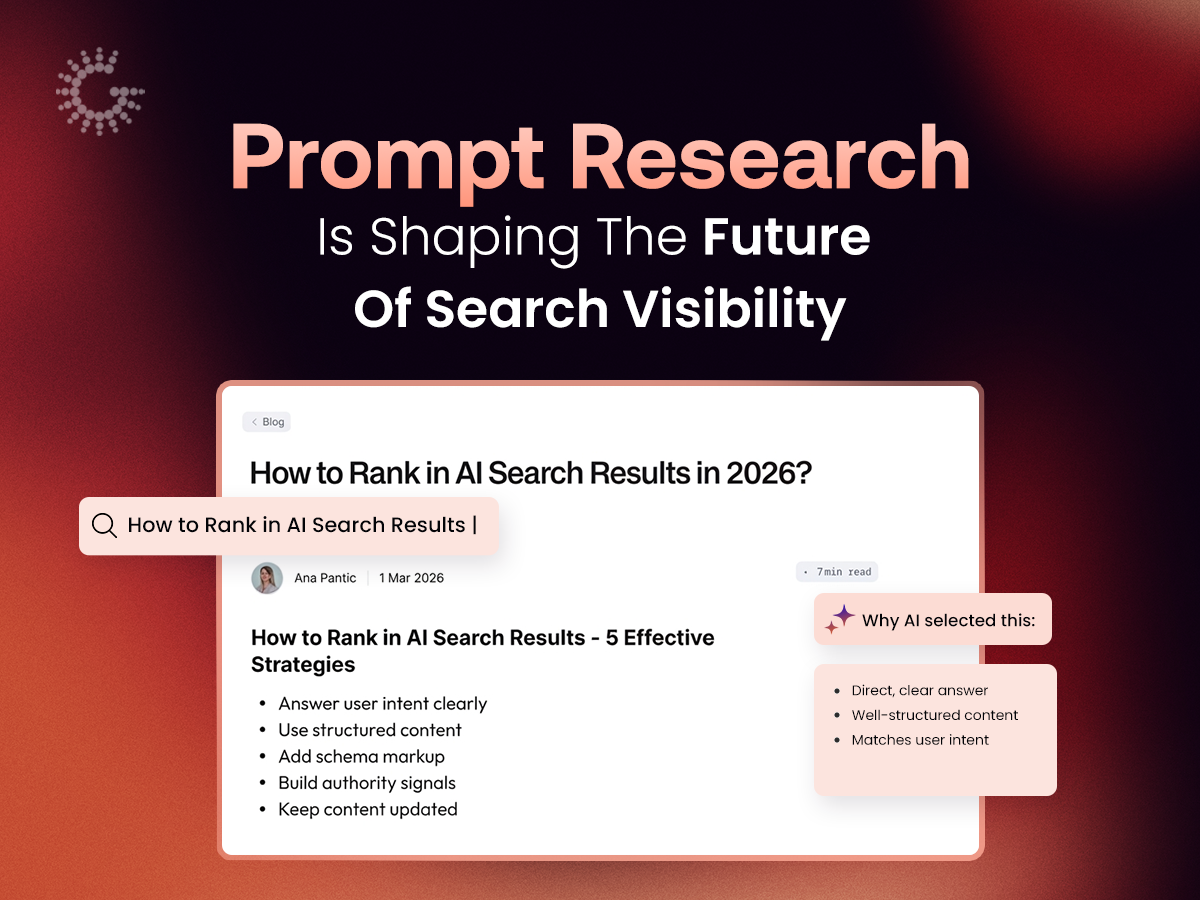
Most people found things online in a familiar way up to this point. They typed a short phrase into Google, looked through the results, clicked a few links and picked the source that seemed best. This behavior shaped SEO for many years. If your content used the right keywords and matched search intent, people had a good chance of finding it.
That model is still important. But the way people search is changing.
More and more discovery journeys now start inside generative AI platforms. Users ask complete questions in these spaces. They give extra context. They improve their request with follow-up prompts. They also want a direct answer over a list of pages in many cases.
This change is affecting how online visibility works.
Search is no longer limited to traditional results pages. It now includes AI summaries, conversational tools and prompt-based interactions that feel like a real discussion. Content strategies, therefore, need to grow beyond targeting keywords alone.
This is where prompt research becomes important.
Prompt research finds and analyzes the questions people ask generative AI systems. In many ways, it is the next step after traditional keyword research.
Keyword research helps marketers understand what people type into search engines. Prompt research helps them understand what people ask AI systems for explanations, comparisons, recommendations or guidance. That difference changes how teams should plan content.
In this article, we will explain the role of prompt research in modern SEO and GEO. We will also discuss how businesses can use it to build a stronger search visibility strategy.
Traditional search usually depended on short, direct queries. Users might search for “best CRM software,” or “how to improve email open rates.” Search engines would return pages based on ranking signals like relevance and authority.
Generative AI has changed that experience.
Users are now more likely to search in natural language with questions like these:
These questions are longer and more specific. They also tend to lead to more prompts.
A user may start with a broad question, read the answer, and then ask follow-up questions to narrow the topic. Search becomes a chain of related interactions in this setting.
Businesses need to understand this because visibility now depends more and more on whether content matches the way these conversations happen.
Prompt research finds and studies the questions people ask generative AI systems. In many ways, it is the next step after traditional keyword research.
Keyword research helps marketers understand what people type into search engines. Prompt research helps them understand what people ask AI systems when they want explanations, comparisons, recommendations or guidance.
That difference changes how teams should plan content.
Prompt research helps businesses understand:
For example, someone researching project management software may start with: “What are the best project management tools for small teams?”
That can turn into follow-up prompts like these:
Prompt research can help find these patterns so teams can create content for the full journey.
Prompt research is becoming more useful for both SEO and GEO as AI discovery becomes more common.
SEO focuses on helping pages rank in traditional search results. GEO focuses on helping content appear in AI answers and generative discovery spaces. These goals are closely connected but they require content to perform well in slightly different ways.
Prompt research helps with both.
For SEO, it helps businesses cover the real questions users ask. This leads to deeper topic coverage, stronger internal alignment and more relevant content planning. For GEO, it helps businesses organize content so generative systems can understand it, connect ideas and combine it into helpful answers more easily.
When businesses understand prompt patterns, they can create content that is more likely to:
In other words, prompt research keeps content useful in a search environment where keywords alone no longer shape results.
Many content strategies still focus on single search terms. A team chooses a target keyword, creates a page around it and hopes the page performs well. That method can still work but it generally misses the wider topic journey users follow today.
Prompt research improves content strategy by moving the focus from single keywords to connected question patterns. This brings several benefits, including these:
People rarely explore a topic with only one question. Someone researching marketing automation may not stop at a definition. They may also want to know how it works, which platforms are best, what results it can improve, how much it costs and whether it fits their business. Prompt research can find those related questions to help businesses create content that covers a topic in depth.
Prompt patterns help businesses see which topics need cornerstone pages, supporting articles, comparison content and FAQ sections. You can build a content structure where each page supports a larger topic cluster.
Prompts show more intent than keywords. A keyword like “payroll software” is broad. A prompt like “What is the best payroll software for a growing healthcare business?” shows business size, industry context and likely needs. That extra detail helps businesses create content that feels more useful to their audience.
Topical authority is still one of the strongest foundations of search visibility. Search engines and generative systems are more likely to trust websites that cover a subject fully and consistently. Prompt research makes that easier by showing the wider range of questions users ask about a topic.
For example, a cybersecurity company may find prompt patterns like these:
These questions clearly show that the topic goes beyond one keyword. It is a bigger cluster of connected concerns.
When a business creates content that clearly answers related questions, it sends a stronger signal that its site understands the topic deeply. Over time, this can improve visibility in both traditional rankings and AI answers.
High-quality content has always needed to be useful. Now it also needs to be easy for AI systems to understand.
Generative systems use content that is well-organized and rich in context. Because of this, structure is more important than ever. Content becomes easier to understand when it includes:
This does not mean content should sound robotic. It simply means writers should present information clearly enough for both people and generative systems to follow. A strong structure makes content easier to scan/understand and more likely to appear in AI answers.
Prompt research does not have to be too complex. In most cases, teams can add it to an existing SEO or content planning workflow. A practical process usually has four stages.
Start by identifying the kinds of questions your audience asks when learning about a topic. These may come from:
The goal is to collect prompts with clear intent, especially questions that involve explanations, evaluations, comparisons or recommendations.
After collecting prompts, teams should group them into related categories. These may include:
Clustering shows how users move from one question to the next. It can also show which topics need wider coverage.
The next step is to connect those clusters to the content strategy. Some prompts may fit pages you already have. Others may show clear content gaps. In many cases, one prompt cluster can support several formats, like:
This helps businesses build a more purposeful and connected content plan.
After teams create the content, they should revise it to make the answers easier to understand. This may include:
These improvements help readers while also making the content more useful in AI search environments.
As prompt research becomes more important, some businesses try to adapt too fast without a clear strategy. That can create new problems.
Prompt research complements SEO and GEO but it does not replace traditional keyword research. Search engines still depend on keywords, topic relevance, authority and page quality. The strongest strategy uses both keyword and prompt insights.
Some businesses focus so much on generative visibility that they forget the content is still for people. Content should stay useful and natural. If it becomes too formulaic or too optimized for machine reading, it could lose value for the audience it is supposed to help.
One prompt rarely tells the whole story. If your content answers only the first question and ignores what users may ask next, it could fail to support the wider discovery journey. Prompt research brings the most value when it helps businesses predict how a conversation will continue.
FAQ sections are useful but they are not enough on their own. Generative systems usually need supporting context, definitions, examples, comparisons and topic connections to interpret information. A page with short answers but little depth may not offer enough value.
Prompt research creates major opportunities, but it also brings new challenges.
One of the biggest challenges is limited transparency. Generative platforms do not always explain how they select sources or how different content affects responses. That lack of clarity makes visibility harder to predict.
Measurement is another challenge. Referral data from AI assistants and generative interfaces is still inconsistent. This makes it hard to directly connect traffic and conversions to AI discovery.
Accuracy is also a concern. Generative systems can sometimes produce incomplete or outdated information. This shows why it is important to publish content that is credible and backed by trustworthy information.
Even with these challenges, the direction is clear. Search behavior is becoming more conversational and businesses that understand prompt patterns will be better prepared to adjust.
A good example is a software company that offers inventory management tools for ecommerce brands. A traditional SEO strategy may target a keyword like “inventory management software.” That keyword is useful, but it covers only part of the opportunity.
Prompt research may reveal wider question patterns like these:
The company could build a wider content structure:
This structure supports both SEO and GEO because it covers the topic and matches current user behavior.
Content strategy needs to change as search changes. Prompt research can help build a stronger system for visibility.
Look beyond keyword tools alone. Review sales conversations, support questions, customer interviews and online discussions to understand how people really describe their needs.
Do not stop at the first question. Think about what users are likely to ask after they get the first answer. Those follow-up prompts can present a deeper content opportunity.
Use prompt patterns to build topic depth. A strong strategy should connect guides, service pages, comparison content and FAQs around the same wider subject.
Organize content with clear headings, short explanations, logical flow and practical examples. A clear structure improves the reading experience and helps generative systems better use the information.
Prompt research should improve content quality. The goal is to create content that is helpful, credible and easy to understand.
Search is increasingly becoming about understanding how people ask questions, how those questions grow through conversation and how AI systems understand the information they find. As a result, prompt research is becoming an important part of the next stage of SEO and GEO.
Prompt research helps businesses move beyond isolated keywords and build content around the real ways people now explore topics. It strengthens topical authority. It improves content structure. And it helps brands stay visible in a search environment that is becoming more contextual and more AI-assisted.
Businesses that start adapting now will be in a stronger position as discovery continues to evolve.
If your business wants to improve visibility across both traditional search and AI discovery, prompt research can be a key part of your content strategy.
At TechGlobe IT Solutions, we help businesses build modern digital strategies that match how people search today. From SEO planning and content development to website optimization and long term visibility strategy, we create systems that support steady growth across changing search environments.
Talk to us today if you want to build a stronger SEO and GEO strategy for the next phase of search.
Prompt research finds and analyzes the kinds of questions people ask generative AI systems. It helps businesses understand how users search in natural language and how those questions grow through follow-up prompts. This process helps businesses create content that works better in both traditional search and AI discovery.
Keyword research focuses on the terms people type into search engines. Prompt research focuses on the fuller questions people ask AI systems, usually with more context and detail. It does not replace keyword research but it adds another layer that helps businesses match content to conversational search behavior.
Search behavior is becoming more conversational as more users interact with AI tools and AI-assisted search experiences. That change means visibility depends more and more on how well content answers real questions. Prompt research helps businesses adjust to that change.
GEO focuses on helping content appear in generative engine responses. Prompt research supports this by finding the kinds of prompts that lead to explanations, comparisons and recommendations. This insight helps businesses create content that generative systems can interpret and surface more easily.
Businesses should focus on prompts that show strong intent, like informational questions, comparative prompts, recommendation-based queries and strategic multi-step questions. These prompts can show what the user wants to understand, evaluate or decide next.
Yes. Prompt research improves traditional SEO by helping businesses build more complete and relevant content around a topic. Many natural language prompts reflect the same concerns users bring into search engines, especially as search queries become more detailed.
Clear, structured and directly useful content usually performs best. Strong pages generally include short explanations, question-based headings, comparisons, examples and FAQs that reflect real prompt patterns. This helps both human readers and generative systems.
No. Prompt research works best as part of a wider content strategy. Businesses need a strong website structure, deep topic coverage, trust signals and ongoing optimization. Prompt research simply helps shape content around how discovery is changing.
One of the biggest mistakes is creating content only for AI systems. Content should still be informative, trustworthy and easy to understand. The goal, after all, is to improve clarity and usefulness.
A practical starting point is to review existing content in a new way. Look at which real questions your pages answer, what follow-up prompts users may ask next, and where topic gaps exist. From there, you can build stronger content clusters that support both SEO and GEO.